Interstate Property Renovation
Key takeaways
- Build and verify your local team before starting work.
- Never rely on listing photographs instead of an independent inspection.
- Put the scope, materials, milestones and payment terms in writing.
- Release payments only after completed work has been verified.
- Use scheduled photographs, video calls and shared project records.
- Keep remote projects cosmetic and easy to specify where possible.
- Arrange independent checks at critical stages.
- Research local regulations, approvals and costs.
- Hold a contingency of at least 10 to 15 per cent.
- Treat poor communication as a risk signal.
An interstate property renovation can help you improve an investment property without limiting your search to your own backyard. It can also expose you to expensive mistakes when you cannot visit the site, check workmanship or chase a silent trade in person.
The answer is not to monitor every nail from hundreds of kilometres away. It is to create a tighter plan, appoint reliable local people and make every payment dependent on verified progress.
Why is renovating an interstate investment property riskier?
Distance removes the informal checks that often keep a renovation moving.
When a property is nearby, you can visit after work, compare what has been completed against the quote and address a problem before it spreads. With a remote renovation, delays can remain hidden, materials may be substituted and incomplete work can appear finished in carefully framed photographs.
The most common renovation risks include:
- Hidden building defects
- Unclear scopes of work
- Unapproved material substitutions
- Poor communication
- Unverified progress claims
- Uncontrolled variations
- Delays and extended vacancy
- Different state licensing and insurance requirements
Distance does not automatically make the project unsuitable. It means trust should never replace verification.
I learnt this firsthand when I renovated a two-bedroom terrace in Newtown while living in Melbourne. I had a trusted builder in Sydney and thought the project was under control, but his availability changed and the renovation was delayed by several weeks. Every extra week meant lost rent, and I could not simply drive over to inspect the property or push things along.
Eventually, my go-to carpenter, Lenny, stepped in and did a fantastic job. He even took care of the small details that can shape a tenant’s first impression. The renovation cost about $30,000 and increased the weekly rent from $570 to $700, so the result was worthwhile. However, the experience taught me that time is part of your renovation budget.
When you are managing remotely, reliable local people, realistic timeframes and clear communication are not optional conveniences. They protect your return. An interstate property renovation can work extremely well, but you must plan for suppliers running late, tradies becoming unavailable and schedules changing.
What local team should you build before renovating?
Your local team should include people who can inspect, coordinate and report independently.
| Team member | Primary responsibility |
| Property manager | Access, photographs and local oversight |
| Builder or project manager | Scheduling, supervision and delivery |
| Building and pest inspector | Independent property assessment |
| Buyer’s agent | Local purchase support |
| Mortgage broker | Funding and cash-flow planning |
| Conveyancer or solicitor | Contract and property checks |
Do not assume renovation supervision is included in ordinary property management fees. Agree on tasks, inspection frequency, authority limits, reporting requirements and charges in writing.
When assessing a builder or project manager:
- Request references from similar recent projects.
- Verify licences and insurance.
- Review a sample progress report.
- Confirm who will supervise the site.
- Ask how delays, defects and variations will be reported.
- Check their responsiveness before paying a deposit.
A polished social media account is not evidence of reliable project delivery. If you are researching how to find reliable tradies interstate, documented references, licence checks and communication habits matter more.
Why is a building and pest inspection essential?
A building and pest inspection for an interstate property can reveal defects that change the scope before you commit.
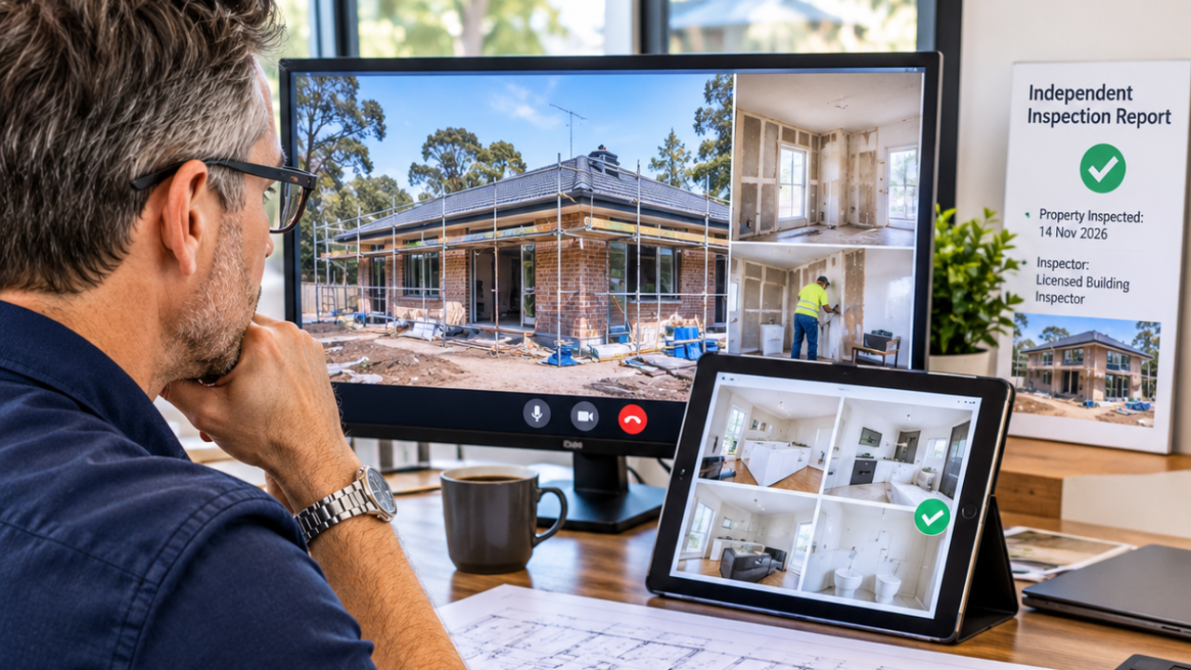
Listing photographs will not reliably disclose moisture damage, termite activity, structural movement, unsafe wiring or unapproved additions. Ask the inspector for a written report with dated photographs, an explanation of urgent defects, recommendations for further investigation and a phone or video debrief.
The cost of another inspection is generally easier to absorb than discovering significant damage after settlement.
How do written scopes and staged payments reduce risk?
A detailed written scope removes ambiguity, while staged payments limit the money exposed at each milestone.
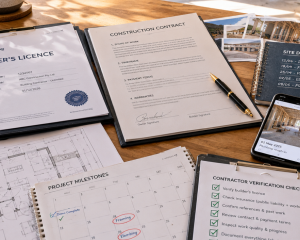
Your contract should state:
- Work included and excluded
- Brands, product codes, finishes and colours
- Start and estimated completion dates
- Approval responsibilities and costs
- The process for approving variations
- Progress milestones and payment amounts
- Defect and rectification procedures
- Warranties, insurance and handover documents
Do not release a payment merely because an invoice has arrived. Verify the milestone through dated photographs, a live video walkthrough, a property manager’s visit or an independent inspection.
Rules governing staged payments vary by state, contract and project type. Obtain legal advice and confirm requirements with the relevant regulator.
How can you prevent a renovation budget blowout?
Control begins with a complete budget, not the cheapest quote.
Include inspections, approvals, professional fees, travel, freight, waste removal, insurance, holding costs, vacancy costs and a realistic contingency.
No variation should proceed through a casual phone call. Require a written explanation covering:
- Why the variation is required
- The proposed solution
- The total cost
- The effect on the schedule
- Your written approval
This creates a decision point instead of allowing several small extras to appear on the final invoice.
What is the best remote renovation management system?
The best approach to remote renovation management in Australia is one reporting routine and one source of truth.
A shared cloud folder, spreadsheet and weekly video call may be enough. Store the contract, scope, product selections, schedule, budget, photographs, inspection reports, invoices, variations, warranties and defects register together.
Ask for weekly updates showing:
- Work completed
- Dated photographs from agreed angles
- Tasks planned for the following week
- Current spending
- Decisions required
- Delays, defects and emerging risks
For detailed areas, request a slow video walkthrough that shows joins, edges, fittings, door operation and unfinished work.
Is a cosmetic or structural renovation better remotely?
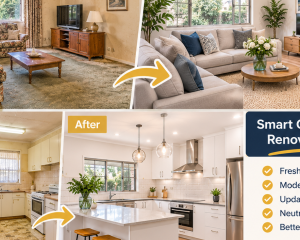
A clearly specified cosmetic renovation is usually easier to control from a distance. Painting, flooring, handles, window coverings and straightforward fixture replacements can be documented using product codes and reference photographs.
Structural work may involve engineers, approvals, demolition, waterproofing and unexpected conditions. It requires stronger supervision, more independent inspections and a larger contingency.
Choose improvements for the target tenant and local market, not your personal taste. Prioritise durable, replaceable and widely available materials.
When should you visit the property?
Visit when an error would be expensive to fix later:
- Before settlement or work begins
- Before concealed work is covered
- Mid-project
- At practical completion
If you cannot attend, engage an independent inspector or suitably qualified local representative. Your builder should not be the only person confirming that the builder’s work is complete.
How do regulations differ between states?
Building contracts, licences, deposits, insurance and approvals vary by location. Council rules, heritage controls and strata requirements may also affect the project.
Before committing, check the relevant building regulator, council requirements, trade licences, insurance, deposit limits, inspection obligations, progress payment rules and variation procedures.
A seven-step remote renovation control plan
- Appoint and verify your local team.
- Obtain independent inspections.
- Prepare a room-by-room written scope.
- Finalise the complete budget and contingency.
- Sign an appropriate contract with milestone payments.
- Schedule reporting and independent checks.
- Confirm approvals before work begins.
Renovating in another state is not a hands-off strategy. It is a management strategy.
The safest approach combines local accountability, written specifications, controlled payments and independent verification. Keep the scope manageable, budget for oversight and act quickly when communication deteriorates.
For practical guidance grounded in more than 20 years of property investing, mortgage and renovation education, ask PropertyChat.AI your interstate renovation question.
You can also ask about Jane’s Trade Discount Card and the discounts available on renovation and everyday purchases.
Suggested related PropertyChat.AI articles
- How to Protect Yourself From a Bad Contractor
- Cosmetic Renovation vs Structural Renovation
- How to Protect Yourself Legally and Financially During a Renovation Contract in Australia
- Renovation Budget Blowout: How to Stop Costs Spiralling
- The Best Tools for Planning and Managing Your Renovation Project
- How Much Does a Quantity Surveyor, Building Inspector and Project Manager Cost in Australia?
This article is provided in line with the Brand Voice of PropertyChat and Your Property Success, emphasising trust, actionable advice, and long-term partnership in property finance.
Transcript
Control Remote Renovations. Avoid Costly Interstate Mistakes.
0:00
Okay, let’s dive right into this explainer. You know, if you’ve ever thought about improving an investment property, but felt kind of well, artificially boxed into your own backyard, you are definitely not alone.
0:11
Renovating across state lines can open up absolutely incredible opportunities.
0:15
But it brings up a really massive question. How do I manage renovation risks when investing in an interstate property? Because without the right
0:23
systems, you are basically exposing yourself to some incredibly expensive mistakes. So today we’re going to fix that. We’re going to give you a bulletproof remote management strategy.
0:33
We’ve got a really clear road map for today. We’ll cover the interstate dilemma, building your local team, protecting your budget, remote
0:41
management systems, and finally the sevenstep control plan. All right, section one, the interstate dilemma, the
0:48
hidden risks of renovating from afar. We really have to ask ourselves this crucial question right up front. Why is
0:55
it riskier? Well, it’s because distance naturally strips away all those informal checks that usually keep a renovation on
1:02
track. Think about it. When a property is just down the road, you can swing by on your way home from work, right? You can check if the tiler actually showed
1:09
up, compare the work against the quote, and squash a problem before it completely spirals out of control. But with a remote renovation, delays just kind of remain entirely hidden.
1:19
materials can be quietly swapped out and incomplete work, well, it can magically appear completely finished if a photograph is framed just right. And
1:28
honestly, that perfectly illustrates our core philosophy for this whole explainer. When you cannot physically check workmanship yourself, you
1:35
absolutely must replace blind trust with a system of rigorous verification.
1:40
Trusting your trades is great. It really is. But relying purely on trust when you’re sitting hundreds of kilome away, yeah, that’s just a recipe for disaster.
1:48
The author of our source material actually learned this the hard way while doing a $30,000 renovation on a two-bedroom new town terrace all the way from Melbourne. They had a trusted
1:57
builder, but suddenly the builder’s availability changed and boom, the renovation was delayed by weeks. Because they were interstate, they couldn’t
2:04
just, you know, drive over and crack the whip. That delayed builder literally cost weeks of lost rent before a super reliable carpenter named Lenny stepped
2:12
in and saved the day. Lenny managed to fine details and push the weekly rent from $570 to $700. It was a great result
2:20
in the end, but it proves a massively vital point. Time is literally part of your budget. Every single extra week of delays eats straight into your ROI.
2:29
Moving on to section two, building your local team, establishing boots on the ground. So, since you can’t be there, you need independent people who can inspect, coordinate, and report back.
2:40
Now, one huge trap investors fall into is assuming their property manager is just going to supervise the renovation for free. Let me tell you, they won’t.
2:48
And honestly, it’s usually outside their expertise anyway. You need to agree on tasks, authority limits, and exactly how they’ll report to you, all in writing.
2:57
And when you’re hiring a builder or project manager, please don’t just scroll through their polished Instagram feed. You need documented references,
3:04
license checks, and a real feel for their communication habits way before you ever hand over a deposit. You must secure a building and pest inspector.
3:13
Carefully framed listing photos are never ever going to show you hidden moisture damage, termite activity, dodgy wiring, or structural movement. A
3:21
wide-angle lens in some good lighting can literally hide thousands of dollars in defects. The cost of hiring an independent inspector is just pennies
3:29
compared to the absolute nightmare of discovering major structural damage the day after settlement. Okay. Section three, protecting your budget, the
3:37
paperwork shield. The absolute non-negotiable rule here is that no budget variation should ever proceed
3:44
from a casual phone call. You must demand these five written explanations to create a hard decision point. You know how it goes. A trady calls and says, “Hey mate, hit a bit of a snag.
3:54
it’ll just be a bit extra. It is way too easy to just say yes on the spot. But those casual little yeses, they snowball
4:01
into a massive final invoice. By forcing every single variation through this formal written process, you stop the
4:08
financial bleed and you maintain total control over your timeline. To prevent a budget blowout, you have to start with a complete budget that includes holding
4:17
costs and a really strict contingency buffer of at least 10 to 15%. And keep in mind, if you’re dealing with an older property, doing structural stuff, or
4:26
just haven’t done complete investigations yet, that contingency slice needs to be even bigger. You also have to factor in those sneaky costs
4:33
everyone forgets. Professional fees, freight, waste removal, and most importantly, the vacancy costs while the property is just sitting there empty.
4:42
Let’s jump to section four, remote management systems. One source of truth.
4:47
The absolute best system for managing remotely relies on a single shared cloud folder for all your warranties, scopes, and invoices paired up with a mandatory
4:55
weekly video call. Seriously, forget the messy email threads and scattered text messages. Just put the contract, the product selections, and the defects
5:03
register in one place. And during that weekly video call, don’t just take their word that things look great. Ask for a slow video walkthrough. Make them point
5:11
the camera at the joints, the edges, the fittings, and especially at any unfinished work. If their communication suddenly goes quiet, you need to treat that as a massive blinking red flag.
5:22
This breakdown really highlights why a clearly specified cosmetic renovation is just vastly easier to control from afar.
5:29
If you’re just doing a cosmetic update, you can literally document the whole thing using product codes and reference photos. You know the exact paint color
5:36
or door handle that’s going in. But the second you start knocking down walls and dealing with waterproofing or engineers, the risk just skyrockets. So whenever
5:45
possible with these remote projects, keep it cosmetic and keep it easy to specify. Even with worldclass remote systems, you or an independent rep
5:54
should physically visit the site at these four critical stages. If you miss them, an error could be incredibly expensive to fix later. Think about it.
6:02
If bad wiring gets sealed up behind brand new drywall, you are in deep trouble. If you can’t get there for these four stages yourself, you
6:09
absolutely must engage an independent inspector or local rep. Never release a progress payment just because an invoice pinged into your inbox. And remember the
6:18
golden rule. Your builder should never ever be the only person confirming that their own work is actually finished. And
6:25
finally, section five, the sevenstep control plan, your project blueprint. By meticulously sticking to these seven steps, you completely shift from this
6:34
vulnerable cross your fingers approach to a commanding management strategy that is driven by local accountability and controlled payments. Notice how heavily
6:43
weighted this list is toward the planning phase. From preparing a strict room by room scope to signing contracts with legally binding milestone payments,
6:50
this blueprint ensures you are never flying blind. And hey, do not skip step seven. Regulations, building contracts,
6:58
and council rules vary drastically between states. So confirming your local approvals before a single hammer swings is non-negotiable.
7:05
So, to actually put these strategies into action, get your highly specific interstate renovation questions answered, and unlock some truly massive
7:13
savings on everyday purchases, you need to head directly to our website at www.propychhat.ai.
7:20
With over 20 years of property investing and renovation education baked right in, it is just an incredible resource. Oh, and while you’re there, definitely ask
7:28
about Jane’s trade discount card. It’s a fantastic way to bring down those base project costs on materials, which directly helps protect that allimportant
7:36
contingency budget we talked about earlier. So, armed with this sevenstep arsenal, how are you going to approach your next interstate opportunity without letting the distance dictate your risk?
7:46
Remember, renovating in another state is not a hands-off strategy. It is a management strategy. By keeping your scopes manageable, relying on written
7:55
verification over blind trust, and deploying an independent local team, you can confidently invest and renovate literally anywhere. Thanks so much for
8:03
joining me on this explainer, and hey, happy renovating.
Frequently Asked Questions
How much contingency should I allow for a remote renovation?
A starting allowance of 10 to 15 per cent is commonly used, but older properties, structural work and incomplete investigations may justify more. Base the contingency on the project’s identified risks.
Should my property manager supervise the work?
A property manager can provide access, photographs and basic progress checks, but full supervision may fall outside their expertise and standard agreement. Confirm their duties and fees in writing.
How do I find reliable tradies interstate?
Seek local referrals, verify licences and insurance, contact recent clients and compare detailed written quotes. Assess communication and responsiveness before awarding a large scope.
Is a construction loan suitable for a remote project?
It may suit larger projects because funds can be released through staged drawdowns. Approval criteria, inspections, timing and fees vary between lenders. Speak with a licensed mortgage broker before signing a building contract.