How to Protect Yourself From a Bad Contractor
Key takeaways
- Use a detailed written contract that defines the work, materials, price, dates, payments and dispute process.
- Check that the contracting person or company is appropriately licensed and insured.
- Tie progress payments to clearly completed and inspected stages.
- Never approve an undocumented variation, even if it sounds minor.
- Keep a site diary containing photographs, invoices, emails and notes.
- Do not terminate a building contract or engage a replacement contractor without obtaining appropriate advice.
- Contact your state or territory building regulator quickly if work becomes defective, incomplete or abandoned.
Knowing how to protect yourself from a bad contractor can mean the difference between a controlled renovation and months of financial and emotional stress. The strongest protection is not a handshake, a friendly relationship or a cheap quote. It is a system built around a detailed written contract, verified credentials, milestone payments and thorough documentation. Put these safeguards in place before work begins and you will be better equipped to prevent misunderstandings, identify warning signs and respond decisively if the work stalls.
The simplest rule is to verify before you trust, document before you approve and inspect before you pay. These habits can help protect your budget, your property and your construction contract homeowner rights.
Why renovation disputes become expensive so quickly
A renovation can look healthy right up until the moment it is not.
The contractor misses Monday, promises to return Wednesday and then stops answering calls. The kitchen has been removed, materials are scattered throughout the house and the next progress payment has already been transferred. When you finally review the quote, you realise it does not clearly define who was responsible for electrical work, rubbish removal or final installation.
This is where a manageable disagreement can become a serious contractor dispute homeowner problem.
The cost is not limited to unfinished work. You may face additional security, inspection, storage, accommodation and completion expenses. Another builder may charge more to investigate and correct work they did not begin. If too much money has already been paid, your negotiating position can become considerably weaker.
The uncomfortable truth is that trust alone is not a renovation management strategy. Good contractors also benefit from precise agreements because everyone knows what is expected, how decisions will be made and what must happen next.
What should a renovation contract include?
Your contract should describe the project so clearly that an independent person could understand what was promised, when it was due and how payment would be earned.
At a minimum, document:
| Contract area | What to specify |
| Parties | Correct legal names, ABNs and licence details |
| Scope | Every included and excluded task |
| Materials | Brands, models, finishes and allowances |
| Price | Fixed price or a clear calculation method |
| Dates | Commencement date, completion date and delay process |
| Payments | Deposit, milestones and evidence required |
| Variations | Written approval, price and time impact |
| Standards | Plans, specifications, approvals and required standards |
| Defects | Inspection, rectification and defects liability process |
| Disputes | Notice, response and escalation procedure |
| Termination | Rights, notices and required steps |
A one-page quote may record a price, but it often fails to explain what practical completion means, how delays will be handled or what happens when hidden damage is uncovered.
If you are researching how to write a contractor contract, remember that a contract must do more than list tasks and costs. It should also explain how risks, delays, defects, variations and disagreements will be managed.
Requirements differ between Australian states and territories. For example, Building Commission NSW explains that residential work over specified values requires written contracts containing prescribed information. Always check the regulator in the state or territory where the property is located.
For a substantial renovation, have the contract reviewed by an appropriately qualified construction lawyer before signing. Paying for clarity before work begins is usually easier and less expensive than arguing about ambiguity after the house has been opened up.
How should contractor progress payments work?
Progress payments should reflect completed work, not elapsed time or the contractor’s cash-flow needs.
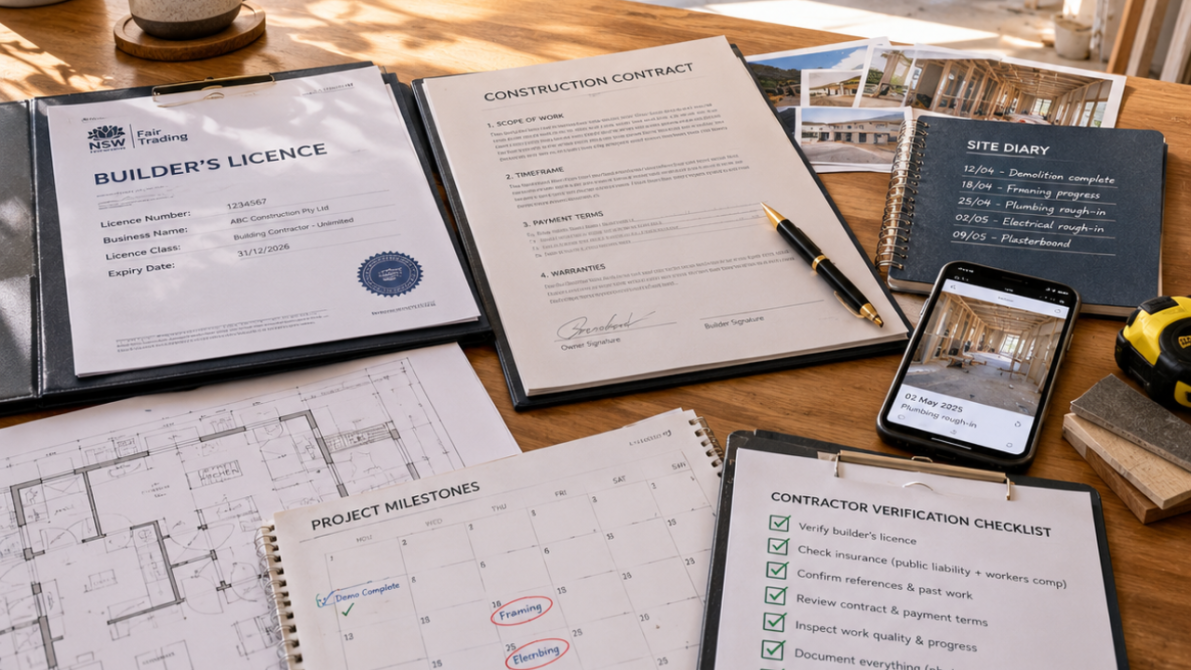
A practical milestone payment schedule contractor agreement might separate demolition, structural work, rough-in services, plastering, cabinetry and completion. Each stage should have an objective definition.
For example, “kitchen nearly finished” is subjective. “Cabinetry installed, benchtop fitted and agreed appliances connected” is easier to verify.
Before releasing a payment:
- Compare the invoice with the contract milestone.
- Visit the site and photograph the completed stage.
- Check that relevant certificates or approvals have been supplied.
- Confirm that defects from the previous stage have been addressed.
- Obtain an independent inspection where the value or technical risk justifies it.
- Keep the invoice and payment receipt together.
The guidance provided by PropertyChat.ai recommends keeping deposits modest, using staged payments and negotiating a final retention into the contract where it is lawful and appropriate.
A commonly discussed deposit is around 10 per cent, but this is not a universal rule. Deposit caps, payment schedules and retention arrangements vary by jurisdiction, project value and contract.
Do not simply withhold money outside your contractual rights. That can create a separate payment dispute. Establish the payment rules before signing and obtain appropriate advice when the contractor’s entitlement to payment is unclear.
For a larger project funded through a construction loan, ask the lender how staged drawdowns and inspections work. This may help prevent funds from being released for work that has not reached the nominated stage. It is a lending matter, so confirm the arrangement directly with your lender or mortgage professional.
How can you verify a builder or tradie?
Check the licence of the person or legal entity that will actually enter the contract. A licence belonging to an individual may not automatically authorise a separate company to contract for the work.
Use your state or territory regulator’s register to confirm:
- the licence is current
- the name matches the contract
- the licence covers the proposed work
- there are no relevant restrictions
- required insurance is in place
Ask for the insurance certificate and verify it with the insurer or relevant scheme rather than accepting a screenshot at face value.
References deserve the same care. Speak to recent clients whose projects were similar in size and complexity. Ask whether the contractor:
- stayed reasonably close to the agreed schedule
- communicated clearly about delays and variations
- provided invoices and certificates when required
- managed defects professionally
- returned to complete agreed rectification work
- remained responsive after receiving payment
If possible, inspect a completed project. Look beyond attractive finishes and ask how the renovation process was managed.
Be cautious when a contractor pressures you to sign immediately, requests an unusually large payment or submits a quote far below every competitor. A cheap quote can become very expensive once omissions, defects and variations begin.
A licensed and insured contractor verification process cannot guarantee that nothing will go wrong. It does, however, help you identify obvious risks before you commit your money and property.
What contractor red flags should you check before signing?
Some warning signs appear before work begins. Pay attention if a contractor:
- refuses to provide a written contract
- cannot produce current licence or insurance details
- asks you to obtain an owner-builder permit unnecessarily
- wants a large upfront payment without explanation
- insists on cash without a proper invoice
- will not provide recent references
- submits a vague quote with no exclusions
- promises approvals are unnecessary without checking
- becomes defensive when asked about variations or defects
- pressures you to sign before you have reviewed the documents
Learning how to protect yourself from a bad contractor is partly about recognising that urgency is not the same as professionalism. A reputable contractor should be able to explain the proposed work, payment process and responsibilities without discouraging reasonable questions.
Why is a site diary so important?
Your memory is not evidence. A dated site diary can be.
Create one digital project folder before the first contractor arrives. Store the signed contract, drawings, insurance, approvals, quotations, invoices and correspondence in separate subfolders.
Your diary should record:
- who attended the property
- work completed that day
- materials delivered
- delays or safety concerns
- verbal discussions and decisions
- photographs taken from consistent positions
- defects identified and responses received
Include the date and a short description with each photograph. Where possible, take wide-angle images showing the location and closer images showing the detail.
After any important conversation, send a calm email confirming your understanding. For example:
“As discussed on site today, the waterproofing defect will be inspected on Thursday and rectified before tiling begins.”
This is not about preparing for a fight. It is about preventing different recollections from becoming a fight.
This article’s core framework is based primarily on renovation guidance supplied by PropertyChat.ai, particularly its focus on contracts, documentation and payment control. PropertyChat.ai draws on more than 20 years of established Australian investing, mortgage and renovation education. It does not provide current market data, perform return calculations or replace legal, financial or personalised professional advice.
How should variations be controlled?
Every variation should be documented before the changed work begins, except where urgent action is required to address an immediate safety risk.
A proper variation records:
- the requested change
- why it is required
- the added or reduced cost
- the effect on the completion date
- revised plans or specifications
- approval from authorised parties
The phrase “while you’re here” can quietly destroy a renovation budget. Five small verbal changes can produce one large invoice, while neither party has a reliable record of what was authorised.
Make written approval part of your standard process. If the cost or delay is unknown, do not approve the work until the contractor explains how it will be calculated.
Keep every approved variation with the original contract so you can see the current total price and revised completion date. This makes it easier to identify whether an invoice relates to the original scope or an authorised change.
What are the signs your contractor is abandoning the project?
One missed day does not prove contractor abandonment. A pattern of deteriorating behaviour deserves attention.
Common signs your contractor is abandoning the project may include:
- repeated unexplained absences
- unanswered calls and emails
- requests for early payments
- materials disappearing from the site
- subcontractors claiming they have not been paid
- constant excuses without revised dates
- work stopping immediately after a payment
- removal of tools without explanation
- reluctance to provide certificates or invoices
Respond early and professionally. Review the contract, identify the relevant milestones and write to the contractor. Describe the incomplete work, request an explanation and provide a reasonable deadline for a written response.
Avoid emotional accusations or threats. A precise written record is more useful than an angry text exchange.
If the contractor responds, ask for a realistic recovery plan containing dates, responsibilities and the remaining work. Do not accept vague promises that are inconsistent with the contract or the condition of the site.
What should you do when a contractor does not finish the job?
If you are wondering what to do when a contractor doesn’t finish a job, your first priority is to preserve safety, evidence and contractual rights.
Follow this sequence:
- Make the site safe. Restrict access to dangerous areas and obtain urgent professional assistance where necessary.
- Stop relying on informal negotiations. Move important communication into writing.
- Review the contract. Check notices, payment obligations, delays, defaults and termination requirements.
- Document the site. Photograph every room, material, defect and incomplete item.
- Obtain an independent assessment. Ask a qualified building consultant to record completed work, defects and likely completion requirements.
- Contact your insurer or warranty provider. Some schemes impose short notification or claim periods.
- Contact the relevant regulator. Your pathway may involve consumer affairs, a building commission or a tribunal.
- Obtain legal advice before termination. Incorrect termination can create serious legal and financial consequences.
The Queensland Building and Construction Commission specifically warns homeowners to obtain legal advice before terminating in non-completion cases. Its non-completion guidance also highlights the importance of securing the property and gathering contracts, variations, payment evidence and correspondence.
Do not immediately bring another contractor onto the site. Doing so may affect evidence, contractual remedies or an insurance claim.
What rights do homeowners have over incomplete contractor work?
Your rights concerning incomplete contractor work depend on the contract, the type and value of the project, the contractor’s conduct and the law in your state or territory.
Depending on the circumstances, possible pathways may include:
- requiring the contractor to complete the agreed work
- requesting rectification of defective work
- disputing a progress payment that is not contractually due
- using a dispute resolution process in the contract
- lodging a complaint with the relevant regulator
- making a claim through an applicable insurance or warranty scheme
- applying to a consumer tribunal or court
- seeking compensation for proven losses
This area can become legally complex. Homeowner rights incomplete renovation questions should be assessed using the actual contract and evidence, not general online advice alone.
[NOTE: The available remedy, regulator and limitation period will depend on the property’s location and the individual circumstances. Obtain jurisdiction-specific advice before terminating the contract, withholding payment or engaging a replacement contractor.]
How are contractor payment disputes usually resolved?
Effective contractor payment dispute resolution starts with the contract and the evidence.
Match every payment against the relevant invoice, milestone and completed work. Prepare a simple timeline showing:
- the original contract amount
- approved variations
- invoices received
- payments made
- work completed
- disputed items
- attempts to resolve the matter
Send the contractor a factual summary and propose a practical resolution. That could involve correcting defects, completing an agreed stage, adjusting an invoice or participating in regulator-supported conciliation.
If direct communication fails, contact your state or territory building regulator. Depending on the jurisdiction and circumstances, further options may include mediation, a rectification process, a consumer tribunal or court proceedings.
Time limits apply. Do not wait until warranties, insurance periods or tribunal deadlines are about to expire.
Can I sue my contractor for not finishing?
If you are asking, “can I sue my contractor for not finishing?”, the answer depends on the contract, the amount in dispute, the evidence and the law in your state or territory.
Court proceedings are not always the first or most cost-effective option. A regulator complaint, tribunal application, mediation or contractual dispute process may be more appropriate.
Before taking action:
- calculate the amount already paid
- document the value of completed work
- obtain a professional assessment of defects and completion costs
- review required default and termination notices
- check regulator, tribunal and insurance deadlines
- obtain legal advice about the available remedies
Legal action can involve cost, time and uncertainty. Clear documentation makes it easier for an adviser to assess whether your claim is commercially practical.
Renovation protection checklist
Before work starts, confirm that you have:
- verified the contracting entity and licence
- checked applicable insurance
- spoken to recent clients
- signed a detailed contract
- attached plans and specifications
- agreed on objective payment milestones
- documented the variation process
- created a site diary
- arranged independent inspections where appropriate
- saved regulator and insurer contact details
Renovation risk cannot be removed completely, but it can be controlled.
The strongest protection is a clear paper trail supported by sensible payment control. Define the work, verify the contractor, inspect completed stages before paying and record every variation. If work stops, protect the site and preserve your evidence before taking irreversible action.
You do not need to predict every possible problem. You need a practical system that helps you recognise risk early and respond calmly.
For practical questions about planning and managing your renovation, start a conversation with PropertyChat.ai. You can draw on more than 20 years of established investing, mortgage and renovation education to identify the questions you should ask next. For contract termination, disputes, lending decisions or personalised advice, also consult an appropriately licensed legal, building or financial professional.
Suggested related articles
- How to Protect Yourself Legally and Financially During a Renovation Contract in Australia
- Renovation Legal Rights in Australia: What You’re Owed
- How to Prevent Builder Issues From Destroying Your Property Investment
- Common Renovation Mistakes: Avoid Pitfalls as a First-Time Renovator
- Renovation Budget Blowout: How to Stop Costs Spiralling
- The Best Tools for Planning and Managing Your Renovation Project
This article is provided in line with the Brand Voice of PropertyChat and Your Property Success, emphasising trust, actionable advice, and long-term partnership in property finance.
Transcript
Protect Your Renovation Before Contractor Abandons It
0:00
Are you getting ready for a renovation?
0:02
Or maybe you’re in the thick of one right now? Well, how can you actually protect yourself against incomplete work, messy payment disputes, and worst of all, complete contractor abandonment?
0:13
That’s exactly what we’re going to answer in this explainer, so you can keep your project tightly controlled and avoid months of severe financial stress.
0:20
Let’s dive right in. I mean, just picture the absolute nightmare scenario for a second. Your kitchen is completely gutted. Your builder is nowhere to be
0:28
found. and a massive chunk of your hard-earned cash is already out the door. The truth is, a renovation can look perfectly healthy right up until
0:36
the exact moment it doesn’t. Your contractor misses a Monday, promises to come back on Wednesday, and then suddenly stops answering their phone
0:43
altogether. Relying on trust alone or a friendly handshake is simply not a real renovation management strategy. To make
0:51
sure you stay in the driver’s seat, here is our road map for today. We’ll cover one, the high cost of trust. Two, bulletproof contracts and payments.
0:59
Three, signs of project abandonment.
1:01
Four, when the work stops, five, resolving contractor payment disputes, and six, protect your property investment. Okay, let’s jump straight
1:10
into part one, the high cost of trust, and exactly why renovation disputes become expensive so incredibly quickly.
1:17
You know, a tiny disagreement can snowball into a full-blown financial crisis practically overnight. Why?
1:23
Because the cost of a bad contractor isn’t just the unfinished work itself.
1:28
It is the cascading hidden expenses that hit you out of nowhere. We’re talking paying for extra security because your site is exposed, coughing up cash for
1:36
temporary storage, or having to extend your own living arrangements. And worst of all, you will absolutely pay a premium for a replacement builder. I
1:44
mean, they have to charge more just to figure out and fix somebody else’s mess.
1:48
Plus, if you’ve already overpaid the first guy, your negotiating position is practically zero.
1:53
Bulletproof contracts and payments. This is going to be your primary shield against those bad outcomes. Look, your absolute best protection isn’t a super
2:02
cheap quote or a friendly chat over coffee. It is a meticulously detailed rule book. Your contract needs to describe the project so crystal clear
2:10
that a total stranger can step in and understand exactly what’s going on immediately. You’ve got to lock down the exact legal names and licenses, every
2:18
single included and frankly excluded task in the scope, and the precise steps for handling variations and disputes.
2:26
Seriously, paying a qualified construction lawyer for a bit of clarity before the sledgehammer swing is always, always going to be cheaper than arguing
2:33
about who meant what after your house is completely torn apart. And speaking of money, a huge glaring red flag is a
2:40
contractor demanding a massive pile of cash up front. Now, legally, deposit caps are going to vary depending on where you live and the overall value of
2:47
your project, but 10% is a very commonly discussed figure. It is a fantastic anchor point to manage your expectations and keep those initial deposits
2:56
perfectly modest. This next point brilliantly illustrates exactly how progress payments should be structured.
3:02
They must always, always reflect objective, verifiable completed work, not just your contractor’s subjective
3:09
need for cash flow. So, never accept a milestone that says something vague like kitchen nearly finished. No way. That is way too subjective. Instead, you want
3:18
milestones like cabinetry installed, benchtop fitted, and agreed appliances connected. See the difference? You can actually walk onto the site, point at
3:26
those specific items, snap a photo, and verify the work before a single scent leaves your bank account. You also really have to watch out for what I call
3:34
the while you’re here trap. You know how it goes. Five casual, hey, can you just tweak this? Verbal changes on site can
3:42
quickly morph into one massive, terrifying invoice at the end of the month. So, the golden rule, always contrast those informal chats with
3:50
professional documentation. Every single variation, unless it is literally an immediate safety risk, needs to be written down with the exact cost and
3:58
time impact spelled out before the work actually starts. signs of project abandonment and how you can recognize
4:05
those early red flags. Spotting these subtle red flags early on is an absolute gamecher for protecting yourself.
4:12
Honestly, some of the biggest warning signs pop up before the work even starts. If a contractor flat out refuses to give you a written contract or they suddenly can’t produce a current license
4:21
or they’re fiercely pressuring you to sign right this second, just walk away.
4:25
Remember, manufactured urgency is definitely not the same thing as true professionalism. Now, what if the project is already rolling? Look, a
4:34
contractor missing one single day doesn’t automatically mean they’ve packed up and fled, but you do need to keep your eyes peeled for a cascading
4:41
pattern of bad behavior. Are there repeated, totally unexplained absences?
4:45
Are building materials mysteriously vanishing from the site? Are you getting nothing but excuses instead of revised completion dates? Or worse, have unpaid
4:54
subcontractors literally knocked on your front door? If you see this happening, those are massive red flags and you need to pay attention immediately. All right,
5:01
part four. When the work actually stops, here’s how to respond decisively and professionally. So, if the worst really
5:09
does happen and the project just grinds to a screeching halt, your number one priority is to preserve safety, your evidence, and your legal rights.
5:17
Whatever you do, do not panic and immediately hire a replacement contractor. If you bring someone new onto the site too fast, you could easily
5:24
destroy your evidence, void your contractual remedies, or completely ruin an insurance claim. Instead, follow this
5:31
exact sequence. Secure the site, switch all your communication to writing, take tons of wide-angle and close-up photos,
5:39
get an independent assessment of the defects, and talk to a lawyer before you even think about officially terminating that contract. And speaking of evidence,
5:47
I need you to remember this. Your memory is not evidence. But you know what is a meticulously maintained dated site
5:54
diary. It is literally the ultimate cure for resolving factual disagreements. Set up a digital folder before the first contractor even steps foot on your
6:02
property. Log exactly who showed up, what they did, what materials arrived, and always follow up any important on-site chats with a polite email
6:10
confirming what was discussed. You aren’t doing this to prep for a fight.
6:13
You’re doing it to prevent two different memories from turning into a fight in the first place. Resolving contract or payment disputes by using cold, hard evidence to find a practical solution.
6:23
If a disagreement over money pops up, you have got to match your sense of urgency with cool, documented professionalism. The absolute best way
6:31
to tackle this is to build a simple timeline. Just line up every payment against the specific milestones in your contract. Write down the original
6:38
contract amount. Add in only the approved written variations. List the invoices you’ve received, the payments you’ve made, and the exact work that is
6:46
verifiably complete. Send that factual, clear-cut summary over to the contractor to propose a practical way forward. Just keep the emotions completely out of it.
6:56
But listen, you have got to be incredibly careful right here. Do not under any circumstances just withhold money outside of your contractual
7:04
rights. If you hold back cash without a solid legal reason, you can inadvertently kick off a totally separate legal dispute where suddenly you are the one breaching the contract.
7:13
Get the payment rules ironed out before you sign anything. And always, always seek professional advice before you decide to freeze any funds. Finally,
7:22
part six, protect your property investment. Let’s look at the final steps for a fully secure renovation. To confidently lock down your home and
7:30
budget on this next project, run through this exact checklist before the very first hammer swings. Make sure the legal entity on the contract actually matches
7:38
their license. Verify their insurance directly with the insurer. Seriously, do not just trust a forwarded screenshot.
7:45
Talk to their recent clients. Sign a contract packed with those objective milestones we talked about. And get that site diary ready to go. The golden rule,
7:53
verify before you trust, document before you approve, and always inspect before you pay. Is your upcoming renovation
8:00
built on a rockolid, legally binding contract, or are you kind of just crossing your fingers and relying on a handshake? Because hoping for the best
8:09
is absolutely not going to protect you when a contractor unexpectedly walks off the job and leaves your property totally exposed. So coming back to our main
8:18
focus, how can you truly protect yourself against incomplete work, payment disputes, and contractor abandonment? Well, to make sure you are
8:26
fully prepared for all of that and to tap into over 20 years of incredible investing and renovation education, you need to head over to property chat.ai
8:34
right now. It is a fantastic resource to help you figure out the exact right questions to ask next to keep your property investment completely safe. Go
8:42
check it out. Take control of your renovation today. And thanks for joining me on this explainer.
Frequently Asked Questions
Can I refuse to pay for incomplete contractor work?
You may be entitled to dispute a payment that is not due under the contract, but withholding payment without contractual grounds can create another dispute. Compare the claim with the payment schedule, document the incomplete items and obtain legal advice if the entitlement is unclear. Do not rely on a verbal agreement when disputing a formal invoice.
Can I hire another contractor when the original contractor disappears?
Not immediately. First document the site, review the contract and contact the relevant regulator, insurer and legal adviser. Engaging someone else too soon can affect evidence, termination rights or an insurance claim. Make sure the original contract has been handled correctly before replacement work begins.
Should I pay a contractor in cash?
Traceable payments provide stronger evidence. Use a method that produces a dated record and insist on an invoice or receipt showing the contracting entity, amount and work covered. Avoid cash arrangements intended to bypass contracts, tax, insurance or licensing obligations.
Does a defects liability period replace statutory warranties?
No. A contractual defects liability period provides a process for reporting and rectifying defects after practical completion. Statutory rights may operate separately and vary by state or territory. Check your contract and the guidance provided by your local building regulator.