
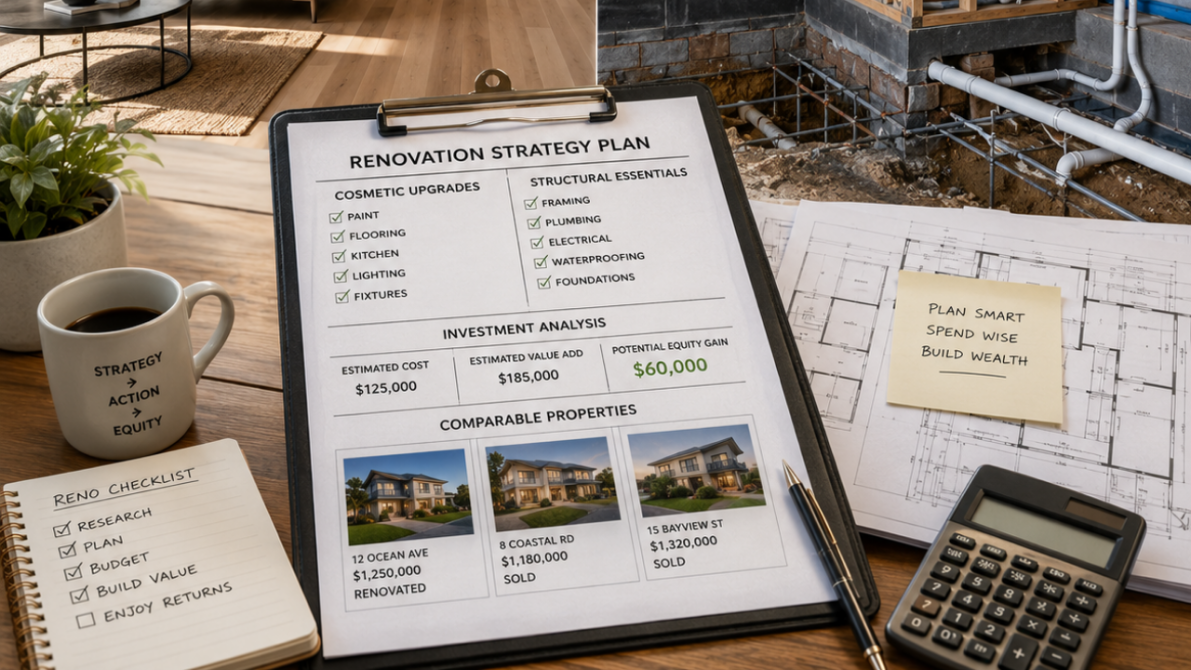
Cosmetic Renovation vs Structural Renovation
Key takeaways
- Complete structural work when required for safety, compliance or functionality.
- Do not assume hidden repairs will increase the property’s value by the amount spent.
- Cosmetic improvements often have greater buyer and tenant visibility.
- Your holding or selling strategy should influence the renovation scope.
- Compare the completed value against the total project cost before starting.
- Use local comparable sales and professional advice rather than a generic percentage.
- PropertyChat.ai provides general education, not current market data, ROI calculations or financial advice.
Choosing between a cosmetic renovation vs structural renovation can determine whether your project creates usable equity or consumes your available cash. For most Australian property investors, the smarter approach is to complete essential structural repairs first, then direct the remaining budget towards visible improvements buyers and tenants value.
Structural work protects the property, but it does not automatically produce a dollar-for-dollar increase in value. A targeted cosmetic renovation can create a more noticeable transformation, often with less cost, complexity and disruption.
Which renovation is more likely to maximise equity?
For a structurally sound investment property, a focused cosmetic renovation will usually offer a clearer path to manufacturing equity than a full structural renovation.
Buyers, tenants and valuers can immediately see a refreshed kitchen, modern bathroom, clean paintwork, attractive flooring and tidy landscaping. Rewiring, replumbing, restumping and roof repairs may be essential, but much of the work disappears behind walls, beneath floors or above ceilings.
This does not make structural work unimportant. It means structural and cosmetic improvements perform different jobs:
- Structural work protects the asset.
- Cosmetic work changes how the asset is experienced.
- A disciplined combination can protect the property while improving its appeal.
I saw this principle play out clearly when I renovated a small two-bedroom unit. The renovation took just 10 days, but it followed six weeks of planning because I wanted every dollar to have a job. I spent $14,000 on visible improvements, including fresh paint, new carpet, a new kitchen and curtains. There was no elaborate redesign or expensive attempt to turn the unit into something the local market did not need. We simply removed the features making it feel tired and created a clean, cohesive home that tenants could picture themselves living in. It was rented before the renovation was finished and, when valued afterwards, the result was $100,000 higher than the previous valuation. That historical result is not a promise that every $14,000 renovation will produce the same uplift. Property, timing and local demand all matter. What it taught me was that successful renovating is rarely about doing the most work. It is about planning carefully and spending where the improvement will be noticed and valued.
What is the difference between cosmetic and structural work?
A cosmetic renovation changes the appearance of a property without substantially altering its structure. A structural renovation changes, repairs or replaces critical parts of the building.
| Consideration | Cosmetic renovation | Structural renovation |
| Main purpose | Improve presentation | Restore safety or integrity |
| Typical work | Paint, flooring, cabinetry and fixtures | Roof, foundations, wiring and plumbing |
| Buyer visibility | Usually high | Often low once completed |
| Complexity | Often lower | Frequently higher |
| Best suited to | Sound but dated properties | Properties with defects |
| Primary role | Improve appeal | Protect the property |
Painting is generally cosmetic, but moving walls, relocating wet areas or altering services can become structural or regulated work. Confirm requirements with qualified builders, engineers, certifiers and your local authority.
Why can a beautiful renovation still lose money?
Visual quality is not the same as financial feasibility. A project can begin with paint, flooring and a modest kitchen update, then expand to relocated plumbing, removed walls, premium finishes and elaborate landscaping.
The finished property may look impressive but exceed the price ceiling for comparable homes.
Overcapitalising becomes more likely when renovators:
- design for personal taste rather than the target market;
- change the scope after work begins;
- confuse maintenance with value creation;
- ignore finance, vacancy, selling and holding costs;
- rely on asking prices instead of settled sales; or
- choose finishes unsupported by the local market.
A realistic feasibility should consider:
Estimated completed value minus purchase and project costs equals the potential project margin.
Project costs may include renovations, reports, approvals, finance, holding costs, vacancy, insurance, tax considerations and selling expenses. Confirm current figures using local evidence and qualified advice.
When is structural work worthwhile?
Structural work is worthwhile when it resolves a genuine safety, compliance, durability or functional problem. Warning signs include significant movement, unsafe electrical systems, water damage, deteriorated stumps, roof failure or plumbing requiring replacement.
A property with serious defects and a stylish kitchen is still a property with serious defects.
When comparing structural renovation cost vs value, consider:
- Asset protection: Will the work prevent further deterioration?
- Functional improvement: Will it make the property safer or more practical?
- Market value: Is there evidence buyers, tenants or valuers will recognise it?
Obtain building inspections, relevant specialist reports, itemised quotations, approval advice and a contingency before committing. Treat structural work as an asset-protection decision first and assess any potential value increase separately.
Which renovations can increase property value?
The best renovations to increase property value usually remove obvious objections and lift the presentation of the entire property.
Paint and flooring
Consistent colours and flooring can make a property feel cleaner, brighter and more cohesive.
Kitchen improvements
Painting sound cabinetry, replacing handles, updating a benchtop or splashback and improving lighting may transform a kitchen without a full rebuild.
Bathroom presentation
New tapware, a modern vanity, updated lighting and fresh grout can improve a tired bathroom. Leaks, mold and waterproofing failures must be addressed properly.
Street appeal and lighting
A clean entrance, maintained garden, repaired fencing and modern lighting can remove visual reminders of age and strengthen the first impression.
Explore the PropertyChat.ai renovation resource centre for more renovation planning guidance.
How should your exit strategy shape the renovation?
For a long-term rental, prioritise durability, tenant experience, safe services and low-maintenance finishes. Improvements may support tenant appeal, competitive rent, functionality and fewer future repairs.
When selling, presentation and emotional appeal carry more weight. Use comparable settled sales to identify buyer expectations and the price ceiling for similar renovated properties. Remember that a higher sale price is not necessarily a profit once renovation, finance, tax, holding and selling costs are included.
How can you avoid overcapitalising?
Start with the completed value and work backwards:
- Define whether the goal is rentability, resale or asset protection.
- Identify the target buyer or tenant.
- Study comparable properties.
- Separate compulsory repairs from optional upgrades.
- Include every project cost and a realistic contingency.
- Test what happens if costs rise or the valuation falls.
- Obtain independent professional input.
- Cost and justify every variation.
For most investors, a sound but dated property with cosmetic potential is more controllable than a building requiring extensive remedial work.
Structural renovation protects people, preserves the building and fixes defects that should never be ignored. Cosmetic renovation can create a stronger visible transformation when the improvements are coordinated and matched to the market.
Ready to assess your renovation before committing your budget? Use the PropertyChat.ai renovation chat to explore your property’s condition, scope and exit strategy. It provides general education, not current market data, ROI calculations or personal financial advice.
Suggested PropertyChat.ai articles
- Which Rooms Should You Renovate Before Selling or Refinancing?
- How Much Equity Should You Aim to Manufacture With Each Renovation Project?
- Renovation Budget Blowout: How to Stop Costs Spiralling
- What to Do If You Discover Structural Issues During Renovation
- The Best Renovations That Instantly Boost Property Value in Australia
- What ROI Can You Expect From Renovating a Rental Property?
- How to Finance a Renovation
This article is provided in line with the Brand Voice of PropertyChat and Your Property Success, emphasising trust, actionable advice, and long-term partnership in property finance.
Transcript
Structural vs Cosmetic: Which Actually Builds Equity?
0:00
Hey everyone and welcome to today’s explainer. Today we’re diving into what is honestly the ultimate property investor debate. If you’re out there trying to figure out how to maximize
0:08
your property’s equity without completely draining your cash reserves, well, you’ve landed in the exact right spot. We’re going to break down the actual science of smart property
0:16
improvement using the data and insights we have right in front of us. So, let’s get right into it, shall we? Here is the million-doll question. Should I do a
0:25
cosmetic renovation or a full structural renovation to maximize equity gain? It’s literally the burning question every
0:32
single investor faces when looking at a tired, dated property. Do you, you know, knock down walls and rip up the foundations, or do you just focus on the
0:41
surface stuff? Getting this choice wrong can absolutely tank your profit margin.
0:46
And that right there brings us to our main thesis for this explainer. Today we are breaking down exactly how to manufacture equity without draining your
0:54
cash. We’re going to build a clear strategic framework so that every single dollar you spend has a specific job and more importantly a specific return.
1:03
Section one, the big equity question. So for a structurally sound investment property, a focused cosmetic renovation
1:10
usually offers a much clearer path to manufacturing equity than a full-blown structural one. Why is that? Well, it’s pretty simple. buyers, tenants, valuers,
1:20
they instantly see and value a refreshed kitchen or a slick, modern bathroom.
1:24
Buyers just aren’t going to pay a premium for invisible plumbing, right?
1:28
But they will absolutely pay up for a beautiful bathroom. Now, sure, structural work is critical if there are serious defects, but those hidden
1:35
repairs, they rarely give you a dollar for-dollar bump in value. Moving on to section two, cosmetic versus structural
1:43
explained. Think of renovations in two totally distinct buckets. You’ve got cosmetic renovations, which are all about improving presentation. We’re talking paint, flooring, cabinetry,
1:52
stuff with incredibly high buyer visibility. Then on the flip side, you have structural renovations. These are to restore safety and integrity, like fixing a roof, foundations, or rewiring.
2:02
But notice that last point on the list there. Once it’s done, structural work has very low buyer visibility. I mean, a huge chunk of that expensive structural
2:10
work literally just disappears behind walls or under floors. Okay, this is the core rule you absolutely have to memorize. Structural work protects the
2:18
asset while cosmetic work changes how the asset is experienced. You totally need a discipline combination of both, but you really have to understand they are doing very different jobs for you.
2:29
You just can’t expect a massive eyepopping valuation bump from a protective structural expense. It just doesn’t work that way. Let me share a
2:36
real world example from our source material that proves this perfectly. $14,000.
2:42
In one specific case study of a small two-bedroom unit, the actual renovation took just 10 days. Though, mind you, it
2:49
followed 6 weeks of really meticulous planning. The investor spent exactly $14,000 on highly visible, punchy
2:56
improvements, fresh paint, new carpet, a new kitchen, and some curtains. No crazy elaborate redesigns, just spending the
3:04
money exactly where people would actually notice it. And look at the result. a massive $100,000 valuation uplift. The property was literally
3:13
revalued at a h 100red grand higher than before they started. Now, obviously, the specific property, the timing, local demand, all of that matters. This isn’t
3:20
some magical guarantee for every single house out there. But the takeaway here is huge. Successful renovation is rarely about doing the most work. It’s about
3:28
planning incredibly carefully and spending precisely where that improvement is valued by the market.
3:33
Section three, the over capitalization trap. Now consider this striking reality for a second. A property with serious
3:41
defects in a stylish kitchen is still a property with serious defects. You can never ever ignore essential safety and
3:48
compliance repairs. Honestly, structural work is absolutely essential when it resolves genuine safety, compliance, or
3:55
functional problems. Protecting the asset must always come first. No exceptions. So, how do these visually beautiful renovations actually end up
4:04
losing money? while over capitalizing happens when you exceed your local price ceiling. And the traps are super common.
4:10
People design for their own personal taste instead of their target market. I mean, nobody needs goldplated taps and a basic starter rental, right? Other
4:17
massive traps include changing your scope of work midway through, confusing basic everyday maintenance with actual value creation, or, and this is a big
4:25
one, relying on asking prices in the neighborhood instead of actual settled sales. Dodging these traps is exactly how you protect your margin. Let’s
4:33
actually define what that margin is. The potential project margin is your estimated completed value minus both the purchase price and your project costs.
4:41
Visual quality is not the same thing as financial feasibility. Your project costs aren’t just the pretty tiles in the paint. You’ve got to factor in
4:48
holding costs, finance charges, vacancy periods, insurance, and selling expenses. If you aren’t running this exact equation, you’re basically flying
4:56
blind. Which brings us to section four, upgrades that add value. The absolute best renovations remove obvious
5:03
objections and just lift the entire property’s presentation. Check out this rapidfire list. Consistent paint and flooring. They instantly make a space
5:12
feel bright and cohesive. Kitchen improvements like just painting structurally sound cabinetry or updating the benchtops that can completely
5:19
transform a room without needing a full tear out. Bathroom presentation can totally be saved with a modern vanity, some new tapware, and fresh grout. And
5:27
finally, street appeal and modern lighting. Those instantly strengthen that crucial first impression when a buyer pulls up to the curb. But here is
5:35
the real secret sauce. Your exit strategy has to completely dictate your material choices. If your ultimate goal is a long-term rental, you’ve got to
5:43
prioritize durability, safe services, and lowmaintenance finishes. But if you’re fixing it up to sell, presentation and emotional appeal carry
5:50
way more weight. You literally must match the renovation to the specific outcome you want at the end of the day.
5:56
Section five, shaping your renovation strategy. The trick here is you have to work backwards. Step one, start with the
6:04
completed value based on local comparable settled sales. Step two, identify exactly who your target market
6:11
actually is. Step three, strictly separate your compulsory structural repairs from those optional nice to have
6:18
cosmetic upgrades. And step four, include absolutely every single project and holding cost plus a realistic contingency fund. If you stick to this
6:27
framework, you heavily heavily insulate yourself against over capitalizing.
6:32
Section six, next steps with property chap. For most investors, finding a structurally sound but dated property
6:39
with serious cosmetic potential is usually the most controllable and profitable investment vehicle out there.
6:45
So, I’m going to leave you with this question. Are you ready to thoroughly assess your renovation before committing your hard-earned budget before you swing
6:52
a single hammer or sign any contractor agreements? Have you done the math? Have you figured out if a cosmetic or structural path is actually the best
7:00
7 minutesmove for your specific property? If you want to dive deeper and really plan this out properly, you need the right tools.
7:07
I highly, highly encourage you to visit https/propy chat.ai AI to explore your property’s
7:16
condition, define your exact scope, and lock in that exit strategy. They provide incredible general education and the exact resources you need to plan your next profitable renovation project.
7:26
Thank you so much for joining me on this explainer. Remember, you can’t paint over a bad foundation, but a smart cosmetic update that just might paint
7:34
your path to early retirement. Happy renovating.
Frequently Asked Questions
Does a structural renovation always add value?
No. It may protect the property and address defects, but the valuation increase may not equal the amount spent.
Is a cosmetic renovation worth doing before selling?
It may be when the property is structurally sound and comparable renovated homes demonstrate sufficient buyer demand.
How much should I spend on an investment property renovation?
Work backwards from conservative comparable sales, subtract all project costs and allow a realistic contingency.
Should I obtain a depreciation schedule after renovating?
A qualified quantity surveyor can advise whether one is appropriate. It may identify eligible deductions but does not guarantee an equity gain.