
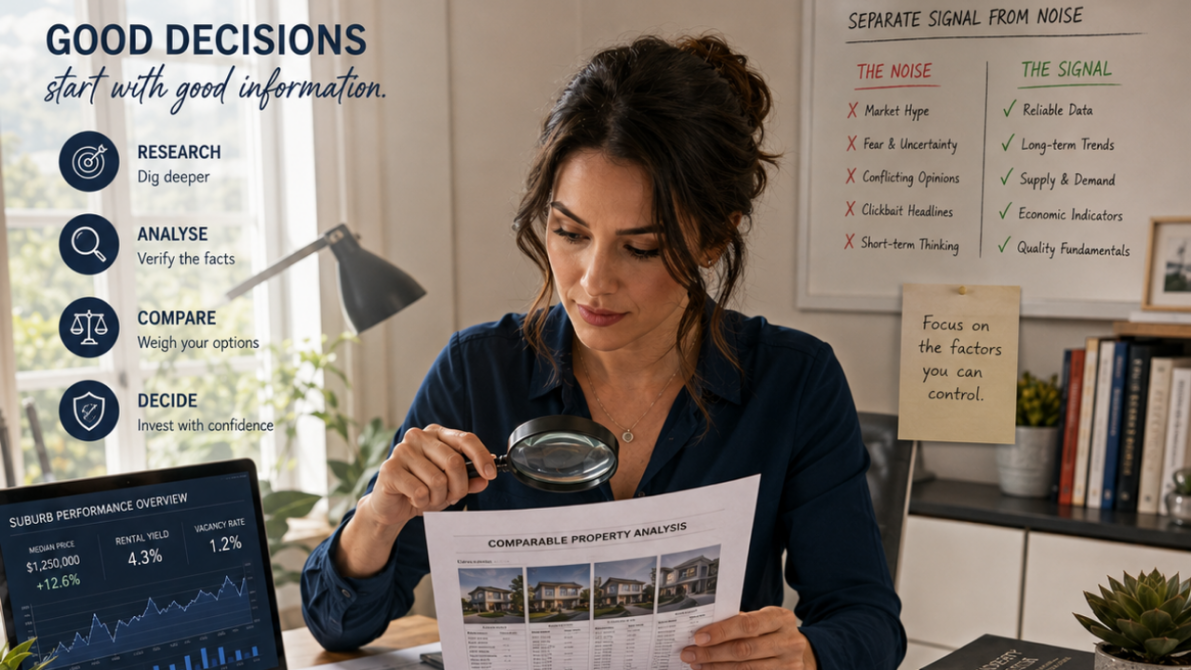
Reliable Property Investment Information
Key Takeaways
- Trace every significant claim back to its original data source.
- Prefer transparent organisations that explain their methodology.
- Treat forecasts as opinions, not guaranteed outcomes.
- Compare long-term fundamentals instead of reacting to one headline.
- Identify how the person providing information gets paid.
- Check evidence across several independent sources.
- Match advice to your goals, finances, timeframe and risk tolerance.
- Use PropertyChat.ai for general education, then verify current information and consult qualified professionals.
Reliable property investment information is not found by following the loudest expert or collecting endless suburb predictions. It comes from checking where claims originated, understanding how the data was calculated and deciding whether the source’s interests align with yours.
For an aspiring Australian investor with a mortgage, family responsibilities and limited research time, this distinction matters. Conflicting opinions can leave you second-guessing every decision. The answer is not more content. It is a disciplined way to separate measurable evidence from marketing, headlines and personal opinion.
Why Is Online Property Investing Advice So Confusing?
Online advice becomes confusing because commentators use different data, timeframes, definitions and commercial objectives.
One expert may discuss the next six months. Another may evaluate a suburb as a ten-year investment. A developer may focus on new stock, while a long-term investor may prefer established properties. Both can sound convincing while answering different questions.
This is how analysis paralysis in property investing develops. Each new opinion seems to undermine the last. Researching feels productive, but it prevents you from establishing buying criteria or making a well-informed decision.
I saw this repeatedly during the ten years I ran monthly Q&A sessions on property investing, renovation and finance. After teaching people how to research a suburb and assess the evidence, someone would occasionally say, “But I was talking to a taxi driver, and he said I shouldn’t invest in Williamstown.”
My business partner, John, and I came to recognise the refrain: “But the taxi driver said…” Sometimes it was a parent, friend or colleague instead. Their concern was usually genuine, but their confidence could give an unsupported opinion more influence than the research sitting in front of the investor.
My response was not that people should ignore everyone around them. It was that every claim should meet the same standard. What evidence supports it? Is it current? Does the person understand your strategy? Are they considering the same risks and timeframe?
A well-meaning opinion may reveal a question worth investigating, but it should not automatically outweigh verified data. When conflicting voices create doubt, return to your criteria, check the original sources and let the quality of the evidence determine what deserves your attention.
How Can You Check Whether Property Information Is Trustworthy?
Start with provenance, which means identifying where the information came from.
When someone makes a claim about prices, population, rental demand or future growth, look for the original source rather than accepting a polished chart or confident conclusion.
Credible Australian sources may include:
- The Australian Bureau of Statistics
- State and territory government agencies
- Local councils
- SQM Research
- Cotality, formerly CoreLogic in Australia
- Research providers that publish their definitions and methodologies
A trustworthy article should identify the reporting period, geographical area, metric and source.
Be cautious when a claim:
- Appears without an original source
- Uses phrases such as “set to explode”
- Presents a percentage without context
- Relies on unnamed experts
- Uses old data to describe current conditions
- Presents a forecast as guaranteed
A quick credibility test
Ask:
- Who produced the information?
- Where did the data come from?
- When was it collected?
- How was the result calculated?
- Does the publisher benefit if I believe it?
If you cannot answer these questions, treat the claim as a starting point for research, not evidence supporting a purchase.
What Property Fundamentals Should You Verify?
Focus on measurable fundamentals rather than predictions.
Population and household demand
Investigate local population and household formation. Consider why people are moving to the area and whether housing supply is increasing faster than demand.
Rental demand
Review vacancy rates across several periods. Examine leasing times, advertised properties and the homes local tenants choose. Ask property managers which dwelling types receive the most enquiries and which streets or properties tenants avoid.
Supply and development
Check council planning documents, development applications and land releases. Distinguish between projects that are proposed, approved, financed, under construction and likely to be completed.
Employment and infrastructure
Look for diverse employment rather than dependence on one employer or industry. For infrastructure projects, check funding, approvals and delivery schedules. Consider whether the anticipated benefit is already reflected in prices.
Historical performance
History does not guarantee future growth, but it can reveal how an area performed through different conditions. Compare long-term trends across multiple sources.
What Are the Biggest Red Flags?
The strongest warning sign is an undisclosed commercial agenda.
Receiving a fee does not automatically make someone untrustworthy. Hiding that fee, referral relationship or incentive is the problem.
| Red flag | What to ask |
| Guaranteed growth or returns | What evidence supports this? |
| No original data source | Where did this number come from? |
| Urgent pressure to buy | What happens if I wait and verify it? |
| One property suits everyone | Why does this suit my goals? |
| Cherry-picked statistics | What does the longer trend show? |
| One provider controls the transaction | Who is paid, by whom and how much? |
| Criticism of independent advice | Can my solicitor or adviser review this? |
Be careful when “education” leads immediately to a property available through the educator’s associated business. Slow down and have the contracts, finance structure and assumptions reviewed independently.
How Should You Compare Conflicting Advice?
Compare the inputs before comparing the conclusions.
Create an evidence table covering:
- Claim: What is being recommended?
- Source: What evidence supports it?
- Date: Is the information current?
- Method: How was the metric calculated?
- Timeframe: Is the conclusion short-term or long-term?
- Incentive: Does the source benefit?
- Relevance: Does it apply to your strategy and risk position?
Give more weight to sources that explain their assumptions, separate facts from forecasts, acknowledge uncertainty, disclose commercial relationships and encourage independent verification.
What Is the Best Research Process for a Beginner?
1. Define your decision
Write down your budget, strategy, cash buffer, timeframe and deal breakers.
2. Build a source hierarchy
Use:
- Government and primary data
- Transparent market research
- Qualified professional advice
- Local first-hand evidence
- General commentary and social media
3. Triangulate important claims
Confirm major assumptions through at least two independent sources.
4. Record dates and definitions
Note each source, publication date, data period, geographical boundary, definition and limitation.
5. Speak with local professionals
Agents, property managers, brokers, building inspectors and conveyancers can add practical context. Compare their responses and consider any commercial interests.
6. Review the property against your strategy
Ask whether you can manage the holding costs, vacancies, repairs and unexpected expenses. Have qualified professionals review relevant legal, financial and building risks.
Where Does PropertyChat.ai Fit Into Your Research?
PropertyChat.ai is an educational starting point built from more than 20 years of Jane Slack-Smith’s experience across property investing, mortgages and renovation.
Use it to understand terminology, organise research questions, create a due-diligence checklist and prepare questions for qualified professionals.
PropertyChat.ai does not provide live market analysis, personalised financial advice or guaranteed property recommendations. Verify current claims against primary data and discuss financial, tax, credit and legal decisions with appropriately qualified professionals.
The solution to conflicting advice is not finding one personality who appears to know everything. It is creating a repeatable filter that no headline, salesperson or viral prediction can bypass.
Check provenance. Understand methodology. Examine fundamentals. Identify incentives. Verify material claims independently.
Ready to replace endless scrolling with a clearer research process? Ask your property investing question at PropertyChat.ai and use the response to build your due-diligence checklist.
Suggested Related Articles
- Analysis Paralysis in Property Investment: How to Move Forward With Confidence
- Who to Trust in Property Investment: Your Guide to Avoiding Scams
- How to Compare Investment Properties
- How to Pick the Right Suburb for Investment Growth
- How to Avoid Buying the Wrong Property and Losing Money
This article is provided in line with the Brand Voice of PropertyChat and Your Property Success, emphasising trust, actionable advice, and long-term partnership in property finance.
Transcript
Stop Following Property Experts. Compare the Evidence Instead.
0:00
Welcome to this explainer. Look, today we’re cutting straight through all that massive noise in the real estate market and we’re going to build a totally
0:07
bulletproof framework for finding reliable property investment information. Because let’s face it, if you’ve ever felt completely overwhelmed
0:14
by contradictory market predictions or found yourself second-guessing a really big financial decision, you are in the exact right place. We’re going to
0:22
separate the cold hard evidence from the marketing spin. So, if you’re feeling bogged down by all that conflicting advice, don’t worry. Today’s agenda is
0:31
super clear. We’re covering the property advice trap, building your information filter, measuring the fundamentals, spotting those red flags, setting up
0:39
your research framework, and then how to kick things off with property chat.ai.
0:44
All right, let’s jump straight into part one, the property advice trap. There is this brilliant anecdote from our source
0:51
material that just perfectly nails the problem we’re facing. So Jane Slacksmith spent a decade running these monthly Q&A sessions on property investing. And
0:59
after painstakingly teaching people how to research a suburb and assess all this hard evidence, an investor would inevitably raise their hand and say, “But I was talking to a taxi driver and
1:08
he said I shouldn’t invest in Williamstown.” I mean, the concern is genuine, right? But it’s totally absurd when you really stop and think about it.
1:14
We routinely let these well-meaning but completely unsupported opinions from a random cab driver or a buddy outweigh actual verified research. And you can
1:23
see that stark contrast right here. On one side, you’ve got these well-meaning opinions, flashy news headlines, and personal anecdotes. But on the other
1:31
side, verified, measurable data that actually aligns with your specific goals. Look, a casual opinion from a friend might spark an interesting
1:40
question, sure, but it should absolutely never automatically outweigh verified data. You have to hold every single claim to the exact same standard. Is the
1:49
evidence current? Does it match your time frame? Does it even fit your risk profile? That brings us to section two,
1:55
your information filter. The absolute most critical concept for you as an investor is providence. Now, providence
2:03
just simply means identifying exactly where the information came from rather than blindly accepting some polished chart or super confident conclusion from
2:11
a charismatic speaker. So when someone makes a really bold claim about future growth or rental demand, your very first
2:18
reflex, literally every time, needs to be tracing that claim back to its original data source. It has to become an automatic defense mechanism for you.
2:28
Before you trust a forecast or a statistic, you have to actively interrogate the data. You need to ask some pretty fundamental credibility
2:35
questions. Who produced this information? Where did the data actually come from? When was it collected? and crucially, do they benefit financially
2:42
if I believe it? If you can’t answer those questions, well, you need to treat that claim as a starting point for your own research, not a solid evidence to
2:50
support a massive six or seven figure purchase. You’ve got to uncover those hidden commercial agendas.
2:56
So, where should you actually be looking for the raw materials to bypass all the marketing spin? You need to go directly
3:03
to trustworthy primary sources. In Australia, this means pulling data straight from the Australian Bureau of Statistics, state and territory government agencies, and local councils.
3:13
And for specific market data, you want to turn to transparent research providers that actually publish their methodologies. Places like SQM research
3:21
and Kotality. These are the sources that give you a factual foundation you can build on with real confidence. Okay.
3:28
Part three, measuring the fundamentals.
3:31
A reliable investment is never based on one sensational headline. A truly healthy market requires a solid balance
3:39
across four key pillars. It’s kind of like a four-legged stool. You need strong population and household demand, high rental demand, carefully managed
3:47
supply and development, and diverse employment and infrastructure. You want to see exactly why people are actually moving to an area. And you absolutely
3:55
need to make sure that new housing supply isn’t somehow increasing faster than the demand for it. And to verify those pillars, you’re going to have to roll up your sleeves a bit and check the
4:04
concrete metrics. Don’t just take someone’s prediction as gospel. Go review the vacancy rates and leasing times across different periods. Check
4:12
the council planning documents and land releases so you actually understand the future supply. You’ll want to look for diverse local employment, too, just so
4:20
the area isn’t totally dependent on a single industry. And finally, compare the long-term historical performance trends rather than just focusing on the
4:27
short-term hype. History doesn’t guarantee future growth, of course, but it definitely shows you how an area weathers different economic storms.
4:35
Moving right along to section four, spotting the red flags. Think of this as your ultimate shield. Whenever someone
4:42
promises you guaranteed growth or returns, your immediate question has to be, “Okay, what exact evidence supports this?” If you’re feeling urgent pressure
4:51
to buy, push back. Just ask, “What happens if I wait and take the time to verify this?” If they’re throwing cherrypick statistics at you, ask what
4:59
the longerterm trend actually shows. And if there is no original data source provided whatsoever, demand to know exactly where that number came from. You
5:07
always have to treat forecasts as potential scenarios, never as concrete facts. But above all else, the absolute strongest warning sign is an undisclosed
5:16
commercial agenda. Let’s be crystal clear here. Someone earning a fee for their services is not inherently a bad
5:23
thing. But actively hiding a fee or a commission or some referral relationship, that is the ultimate deal breaker. If a so-called education
5:32
program leads immediately into pressure to buy a property through that educator’s associated business, you need to hit the brakes. Always, always get
5:40
the contracts and finance structure reviewed completely independently. Which brings us to section five, your research
5:47
framework. Here is your six-step process for real clarity. Step one, define your budget, strategy, time frame, and deal
5:55
breakers right out of the gate. Step two, build a source hierarchy.
5:59
Basically, prioritize government data and transparent research way above some random social media commentary. Step three, triangulate important claims. You
6:08
do this by confirming major assumptions across at least two totally independent sources. Step four, meticulously record your dates, sources, and definitions.
6:18
Step five, get out there and speak with local professionals like property managers and building inspectors for actual on the ground context. And step
6:25
six, review the property strictly against your own strategy. If you follow this playbook, you create a filter so tight that no viral prediction or slick
6:33
salesman is ever going to bypass it. And finally, section six, start with property chat.ai.
6:41
So to really put all of this into practice, I highly recommend making property chat.ai AI, your primary educational starting point. Seriously,
6:49
this tool is built directly from more than 20 years of Jane Slack Smith’s extensive experience across property investing, mortgages, and renovations.
6:57
It’s just an incredible resource to help you actively navigate everything we’ve talked about today. Now, just to be clear, property chat.ai isn’t going to
7:05
magically choose an investment property for you, and it doesn’t provide personalized financial advice or live market analysis. But what it does do is
7:12
act as the perfect tool to help you make sense of complex terminology, organize your endless research questions, and build a rockolid due diligence
7:20
checklist. It essentially preps you with the exact right questions to ask before you even sit down to consult with appropriately qualified professionals.
7:27
It completely empowers you to take control of the whole process. So my final question for you today as we wrap up this explainer is simply this. Are you ready to stop letting the market
7:36
confuse you and start using this framework to invest with some true clarity? Look, the solution to conflicting advice isn’t finding a magic guru who knows everything. It’s about
7:44
building a process that you can deeply, fundamentally trust. Head over to property chat.ai right now. Go ask your most pressing property question and use
7:52
that response to start building your due diligence checklist today. Thanks so much for joining me on this explainer and happy researching.
Frequently Asked Questions
How do I know if an online property source is credible?
Look for original sources, publication dates, clear methodologies, qualified authors and transparent commercial relationships. Verify unsupported claims elsewhere.
Should I trust property market forecasts?
Treat forecasts as scenarios, not facts. They should not replace current data, property-specific due diligence or professional advice.
How do I vet a property investment adviser?
Check qualifications, experience, fees, commissions and referral arrangements. A trustworthy adviser should disclose conflicts, discuss risks and support independent review.
Can PropertyChat.ai choose an investment property for me?
No. PropertyChat.ai provides general education to improve your questions and organise your research. Verify current information and consult appropriately qualified professionals before acting.