Which Rooms to Renovate Before Selling or Refinancing?
Key Takeaways:
- The kitchen and bathroom deliver the highest renovation ROI in Australia, often returning $2 for every $1 spent
- Focus your budget on visible, cosmetic upgrades rather than structural work when renovating to sell in Australia
- Strategic room prioritisation prevents overcapitalising on renovation and maximises equity gains
- Valuers and buyers both respond to first impressions, curb appeal matters as much as internal updates
You’ve spent months scrolling through renovation shows. The before-and-afters look transformative. The contestants talk about instant equity and life-changing profits. You feel the pull, maybe renovation is your ticket to accelerating your property portfolio.
Then reality hits. You’re standing in your investment property, calculator in hand, trying to figure out which rooms to renovate before selling that actually deserve your hard-earned renovation budget. The kitchen needs work. The bathroom is dated. The paint is tired. The landscaping looks neglected. Where do you even start?
More importantly, how do you make sure you’re not about to flush $30,000 down the drain on upgrades that won’t move the needle when it’s time to sell or refinance?
The short answer: Prioritise the kitchen first, then the bathroom, then paint and flooring, then curb appeal. Everything else is secondary. Here’s exactly why, and how to do it without overcapitalising.
The Problem Most Renovators Face
Here’s the uncomfortable truth. Most property investors approach renovation with their hearts, not their heads. They renovate based on personal taste, trending Pinterest boards, or what their mate did to his place in a completely different suburb.
The result? Budget blowouts. Overcapitalised properties. Renovations that add barely half the value they cost to complete. And the gut-wrenching realisation when the bank valuer walks through and your $40,000 renovation adds only $15,000 to the property value.
You’re not alone in this fear. The Strategic Renovator, someone just like you with resources and ambition but terrified of making an expensive mistake, lies awake at 3am wondering: “What if I sink all this money into the wrong rooms and never see a return?”
The anxiety is real. Because unlike buying the wrong share, you can’t just sell and move on quickly. Property mistakes lock you in. They drain your equity. They stall your portfolio growth. They make you feel like you’re going backwards while everyone else is getting ahead.
Why This Keeps You Stuck
The renovation advice online is either too generic or completely contradictory. One guru says “always renovate the kitchen.” Another says “bathrooms give the best bang for buck.” A third insists “just paint everything white and you’ll be fine.”
Meanwhile, you’re spending weekends at inspections, browsing Bunnings aisles, and watching The Block, trying to piece together a strategy that actually works in your suburb, for your property type, with your budget constraints.
The information overload paralyses you. You procrastinate. Projects drag on. Tradies ghost you. Costs spiral. And that equity you were supposed to manufacture? It evaporates before your eyes.
The real danger isn’t just wasted money. It’s a waste of time. Every month you sit in analysis paralysis is a month of potential portfolio growth you’ll never get back.
The Rooms That Actually Move the Needle
Let’s cut through the noise with a framework built on 20 years of renovation experience, not reality TV drama. When you’re renovating to sell or refinance, three principles should guide every dollar you spend:
Visibility matters more than necessity. Buyers and valuers pay for what they can see and emotionally connect with, not what’s hidden behind walls.
Cosmetic beats structural every time. The new wiring doesn’t photograph well. A stunning kitchen does.
The $2-for-$1 rule is non-negotiable. Every renovation should add at least $2 in property value for every $1 you spend. Anything less, and you’re overcapitalising.
With these principles in mind, here’s exactly where your renovation budget should go.
Room-by-Room Renovation ROI at a Glance
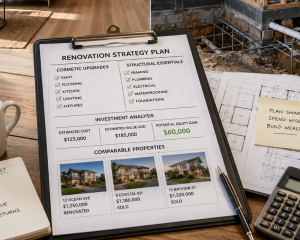
| Room / Area | Typical Cost | Value Added | ROI Potential |
| Kitchen | $15,000 – $20,000 | $30,000 – $40,000 | High |
| Bathroom | $10,000 – $25,000 | $20,000 – $40,000 | High |
| Paint (full property) | $3,000 – $8,000 | $10,000 – $20,000+ | Very High |
| Flooring (key areas) | $5,000 – $15,000 | $10,000 – $25,000 | High |
| Curb appeal | $1,500 – $5,000 | $10,000 – $20,000+ | Very High |
| Structural work | $20,000 – $100,000+ | Variable (often low) | Low |
Those numbers in the table above aren’t hypothetical. I know they work because I’ve lived with them. A few years ago, I picked up a 52-square-metre worker’s cottage in Newtown, Sydney, and managed the entire renovation from Melbourne. My trusted builder Lenny handled everything on the ground: kitchen improvements, gutter repairs, and a thorough tidy-up throughout the property. Nothing structural. No sweeping redesign. Just targeted, strategic work focused on exactly what buyers and valuers could see and emotionally connect with. The renovation came in at $33,000. Six weeks later, the property was revalued, and it went from $820,000 to $920,000. A $100,000 uplift on a $33,000 spend. The story ended up featured in Australian Property Investor magazine, but honestly, the number that mattered most to me was far simpler than that: we more than doubled our return for every dollar spent. That’s the $2-for-$1 rule working exactly as it should. And the rooms we focused on? The kitchen and the cosmetic presentation. Not the plumbing. Not the structure. The visible stuff. That is what moved the needle. That is what this entire framework is built on.
The Kitchen: Your Non-Negotiable Priority
The kitchen isn’t just a room. It’s the emotional centrepiece of any property. When buyers walk through, they imagine their family gathered around the island bench. When valuers assess comparable properties, an updated kitchen immediately places your property in a higher tier.
A well-executed kitchen renovation can easily add $30,000 to $40,000 in value for a $15,000 to $20,000 investment. That’s the $2-for-$1 rule in action, and it’s why the kitchen is always the first room to prioritise when renovating to sell in Australia.
But here’s the critical distinction: you’re not renovating for MasterChef. You’re renovating for mass market appeal. That means:
- Clean, modern benchtops (stone or quality laminate, not marble)
- Neutral, on-trend cabinetry (whites, greys, warm timber tones)
- Functional appliances (stainless steel, nothing too boutique)
- Adequate storage and workspace
- Good lighting (task lighting and ambient warmth)
The renovation ROI in Australia depends entirely on staying within market expectations for your suburb. A $50,000 designer kitchen in a $600,000 suburb is overcapitalising. A $20,000 clean, functional update in the same suburb is strategic wealth-building.
According to insights from PropertyChat.ai, the platform built on two decades of investing and renovation expertise, the kitchen delivers consistent returns because it’s where people spend time and make memories. It’s visceral. It’s visual. It sells properties.
The Bathroom: Small Space, Big Impact
If the kitchen is your non-negotiable, the bathroom is your secret weapon. Bathroom renovation value adds consistently outperforms expectations because buyers notice dated bathrooms immediately, and they emotionally discount properties that have them.
A tired bathroom with cracked tiles, mouldy grout, and a stained shower screen screams “problem property” to buyers. It triggers doubt. It makes them wonder what else has been neglected.
Conversely, a fresh, clean bathroom creates confidence. It signals that the property has been cared for. It removes objections before they form.
A quality bathroom renovation can cost anywhere from $10,000 to $25,000 depending on size and finishes. When done strategically, it should add $20,000 to $40,000 in value. The key is focusing on high-impact elements:
- New tiles (floor to ceiling in wet areas)
- Modern fixtures (tapware, showerheads, vanity)
- Adequate storage (wall-hung vanities create space)
- Proper waterproofing and ventilation
- Neutral, timeless colour palettes
Just like the kitchen, avoid over-specifying. Heated floors and Japanese toilets might thrill you, but they won’t proportionally increase your property’s value in most Australian suburbs. Stick to the sweet spot: quality finishes that look expensive but don’t break the budget.
Paint and Flooring: The Transformation Multiplier
Here’s where most renovators underestimate impact. Fresh paint throughout is one of the highest-ROI renovations you can do. It costs relatively little, typically $3,000 to $8,000 for a full property, and it completely transforms how buyers and valuers perceive the space.
The rule is simple: light, neutral tones. Whites, soft greys, warm beiges. These colours make spaces feel larger, brighter, and more modern. They create a blank canvas that lets buyers imagine their own furniture and style.
Flooring follows the same logic. You don’t need to replace every floorboard in the house. Focus on key living areas and bedrooms. Polished concrete, hybrid timber, or quality laminate all work beautifully in the Australian market.
Avoid the temptation to redo the whole house if it’s not necessary. A well-chosen runner rug can disguise tired hallway carpet. Fresh paint on skirting boards can make existing flooring look intentional. Be strategic, not perfectionist.
Curb Appeal: The First Impression That Sells
You can have the most stunning kitchen and bathroom in the suburb, but if your property looks tired from the street, buyers will drive past without stopping. Valuers will unconsciously downgrade their assessment before they’ve even walked in the door.
Curb appeal renovation in Australia is one of the most underutilised strategies by property investors, yet it delivers outsized returns for minimal spend.
Consider these high-impact, low-cost upgrades:
- Fresh mulch and tidy garden beds ($500 to $1,500)
- A new front door or fresh paint on the existing one ($300 to $1,200)
- A clean, well-maintained driveway and paths (pressure wash or resurface)
- Modern house numbers and letterbox ($100 to $400)
- Outdoor lighting for evening inspections ($200 to $800)
These cosmetic touches cost a fraction of internal renovations but create the emotional momentum that leads to higher offers and better valuations. They signal pride of ownership. They make buyers feel excited before they cross the threshold.
What NOT to Spend Your Money On
Equally important to knowing where to invest is knowing where NOT to waste your budget. When you’re renovating to sell or refinance, avoid these common traps:
Structural and invisible work. New wiring, replumbing, restumping, roof repairs, these are essential for property safety and longevity, but they don’t add dollar-for-dollar value in a sale or valuation scenario. If the property desperately needs structural work, factor it into your purchase price negotiation, not your renovation budget.
Over-specification for the suburb. That $15,000 designer tapware set might be beautiful, but if comparable properties in your suburb sell with standard fixtures, you’ve just overcapitalised. Always research what renovated properties in your area actually sell for before specifying finishes.
Bedroom additions (usually). Adding bedrooms rarely delivers the ROI you’d expect unless you’re converting a 2-bedroom to a 3-bedroom in a family-focused suburb. Beyond that, the cost of adding space, extensions, council approvals, structural work, typically exceeds the value it adds.
Overly trendy finishes. That geometric tile pattern might be Instagram gold today, but it’ll date your renovation in three years. Stick to timeless, broadly appealing choices that won’t age badly.
This is the heart of cosmetic renovation vs structural renovation strategy. Cosmetic upgrades photograph well, appeal to emotion, and deliver measurable returns. Structural upgrades protect the asset but rarely show up in a valuation the way you’d hope.
If You’re Refinancing: What Valuers Actually Look For
Here’s a critical distinction many investors miss. When you’re renovating to sell, you’re appealing to buyer emotion. When you’re renovating to refinance, you’re appealing to value logic.
Valuers assess your property against comparable sales in the area. They look for:
- Evidence of quality finishes (kitchen, bathroom, flooring)
- Overall presentation and condition
- Features that place your property in a higher comparable bracket
- Recent renovation work (preferably with receipts and compliance certificates)
The good news? The same rooms that appeal to buyers, kitchen, bathroom, paint, flooring, also tick the boxes for valuers. The strategy aligns beautifully whether you’re selling or accessing equity through refinancing.
However, when refinancing, timing matters. Renovate, then wait at least 3 to 6 months before requesting a valuation. This allows comparable sales data to catch up and gives valuers confidence that your improvements represent genuine market value, not just fresh paint.
Property valuation renovation tips in Australia always come back to this: document everything, keep receipts, and ensure all work is compliant. Valuers appreciate evidence of quality workmanship.
Your Strategic Renovation Priority List
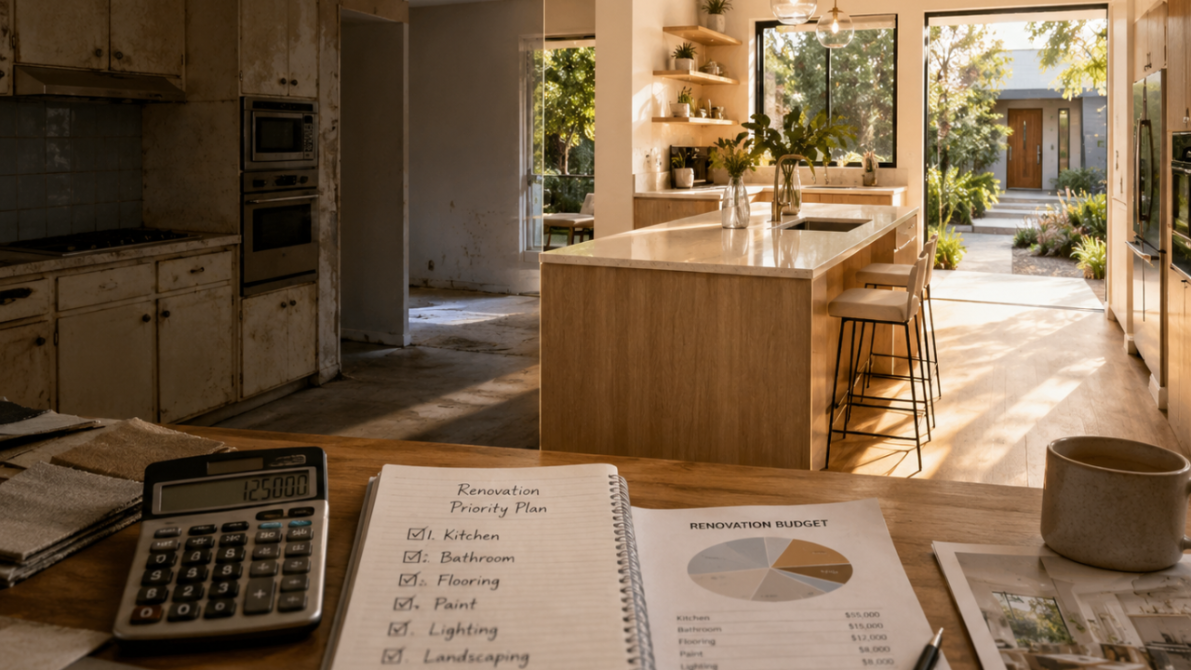
If you’re standing in your investment property right now, calculator in hand, wondering where to start, here’s your definitive priority order based on the best rooms to renovate before selling:
- Kitchen – Your highest-impact, non-negotiable investment
- Bathroom – Small space, big emotional and financial return
- Paint and flooring – Maximum transformation for minimal spend
- Curb appeal – First impressions that drive valuation and buyer interest
- Laundry and additional bathrooms – Only if budget allows and market expectations demand it
Within each category, focus on cosmetic renovation over structural renovation. Visible beats invisible. Emotional appeal beats functional necessity when your goal is maximising value.
And if you’re forced to choose between doing two rooms adequately or one room exceptionally? Do one room exceptionally. A stunning kitchen with a tired bathroom is more valuable than two mediocre spaces. Buyers and valuers notice excellence. They mentally discount compromise.
The Framework That Removes the Guesswork
The difference between a renovation that builds wealth and one that drains equity comes down to strategy, not budget size. You don’t need to spend six figures to manufacture significant equity. You need to spend smart.
That’s where frameworks like the ones developed through decades of real-world renovation experience become invaluable. PropertyChat.ai provides access to proven renovation and investment advice, helping you avoid the costly mistakes that trap most first-time renovators.
The platform doesn’t provide up-to-date market analysis or financial advice. What it does offer is 20 years of solid investing, mortgage, and renovation wisdom, the kind of battle-tested frameworks that help you navigate decisions with confidence rather than guesswork.
Because here’s the truth: renovation isn’t about having the biggest budget. It’s about having the clearest strategy. It’s about knowing which rooms actually move the needle, which finishes deliver returns, and which suburbs reward specific types of upgrades.
Take the Next Step With Confidence
You don’t have to figure this out alone. You don’t have to piece together conflicting advice from a dozen YouTube videos and hope you’ve made the right call.
Strategic renovation is a skill. And like any skill, it’s something you can learn from people who’ve already walked the path, made the mistakes, and refined the process over decades.
Whether you’re preparing to sell or positioning your property for a refinance to access equity, the rooms you prioritise today will determine the financial outcome you achieve tomorrow.
Start with the kitchen. Nail the bathroom. Don’t skip the paint. Remember curb appeal. And always, always apply the $2-for-$1 rule before you commit a single dollar.
That’s how you manufacture equity. That’s how you avoid overcapitalising. That’s how you build a property portfolio that actually grows your wealth instead of just looking good on Instagram.
Ready to renovate with a strategy behind every dollar? Start a conversation with PropertyChat.ai today and get 20 years of renovation and investment expertise at your fingertips, free to start, no fluff, just frameworks that work.
Related Articles from Your Property Success
Explore these articles to deepen your renovation and investment strategy:
- 4 Biggest Mistakes You Can Make When Buying a Property to Renovate – Learn the critical errors that even experienced investors make when buying to renovate, and how to avoid them.
- Refinance Your Way to Renovation – Discover the finance options available to fund your renovation, from refinancing to home equity loans, and how to choose the right one.
- Opening Opportunities With Your Home Equity – Understand how to unlock equity in your property to fund your next investment or renovation project.
- 10 Investment Strategies to Build a Property Portfolio in Australia – A broader look at the strategies successful Australian investors use to grow their portfolios, including renovation-based approaches.
This article is provided in line with the Brand Voice of PropertyChat and Your Property Success, emphasising trust, actionable advice, and long-term partnership in property finance.
Transcript
Prioritise Kitchen, Bathroom, Paint First. Period.
0:00
Welcome to the explainer. Today, we are cutting straight through all that reality TV noise and those overly dramatic before and afters. Instead,
0:08
we’re going to reveal a highly effective, totally datadriven framework for renovating to manufacture equity. If you’ve ever asked yourself, which room
0:16
should I prioritize when renovating to sell or refinance? Well, you are exactly in the right place. Let’s get into it.
0:23
Look, let’s be real for a second. If you’re a property investor, you’ve probably experienced that classic 3:00 a.m. anxiety. You know the one. You’re standing in a tired investment property,
0:32
calculator in hand, just completely paralyzed by the fear of over capitalizing. You know you need to make changes to see your portfolio grow. But the terrifying thought of literally
0:40
flushing 30 grand down the drain on the completely wrong upgrades, yeah, that’s enough to keep anyone up at night. So, how do we fix this? Well, we absolutely
0:49
have to stop making decisions based on emotion or Pinterest trends or whatever we saw on last night’s home makeover show. Instead, we need to completely
0:58
shift our mindset to renovating with our heads. We’re talking strategic ROI, mass market appeal, and bank valuations
1:05
backed by 20 years of real world renovation experience. Okay, let’s just quickly look at our road map for today.
1:12
We’re replacing information overload with a battle tested priority list.
1:16
We’ll cover the over capitalization trap, the core rules of strategic renovation, a room byroom ROI breakdown, where not to spend, the difference
1:24
between buyers and valuers, and your next strategic step. All right, part one, the over capitalization trap and
1:32
why most renovators just stay stuck. The internet is just full of contradictory advice, isn’t it? One guru tells you to
1:39
always do the kitchen, another swears by bathrooms, and someone else says just paint the whole shebang white. This overload leads straight to analysis paralysis. Your projects drag on.
1:49
Treaties end up ghosting you and your costs spiral. And the real danger here, it’s not just the budget blowouts. Every single month you sit there delaying your
1:58
decision is potential portfolio growth that you are simply never getting back. Let’s move right along to section two.
2:07
The rules of strategic renovation. This is our foundational framework. So, the crucial point here is this magic anchor
2:14
number, $2. This is your absolute non-negotiable rule. For every $1 you spend on a renovation, it must add at
2:22
least $2 in property value. Seriously, if it doesn’t do that, you are over capitalizing. It really is that simple.
2:29
Keep this idea front of mind. Visibility matters way more than necessity. Take this real world example of a 52 m
2:37
worker’s cottage in New Town. By sticking strictly to this principle, meaning no major structural redesigns and purely focusing on visible cosmetic
2:45
presentation, a strategic $33,000 spend led to a massive $100,000 valuation uplift in just 6 weeks. I mean, that is
2:54
the two for one rule working to absolute perfection. Which brings us to section three, the priority room ROI breakdown.
3:02
Basically, where to actually spend your money. This hierarchy of returns is a real gamecher. It clearly shows how
3:09
targeted cosmetic updates like kitchens, bathrooms, and paint drastically outperform invisible structural work when it comes to return on investment.
3:18
Let’s break these down one by one, starting right at the top. Number one, the kitchen. Actually, scratch that.
3:24
It’s the non-negotiable priority. It’s the emotional centerpiece of any property. A wellexecuted kitchen can
3:31
easily add $30 to $40,000 in value for just a 15 to $20,000 investment. But here’s the catch, guys. You are
3:39
renovating for mass market appeal, not for Master Chef. Keep it simple. Clean benchtops, neutral cabinetry, and functional stainless steel appliances
3:48
are what win the day here. Next up is the bathroom. Small space, but a huge impact. Think about it. A dated moldy
3:56
bathroom just screams problem property to buyers and valuers. But a$10 to $25,000 strategic update that replaces
4:04
all that doubt with immediate confidence, potentially adding up to $40,000 in value. You want to focus on floor to ceiling tiles in the wet areas,
4:13
modern fixtures, and wall hung vanities to really create a sense of space.
4:18
Moving on to paint and flooring, which I love to call the transformation multiplier. Most renovators wildly underestimate this. For a relatively
4:25
tiny spend, like $3 to $8,000, fresh paint in light neutral tones, completely transforms how the entire space is perceived. It creates a bright blank
4:33
canvas. Pair that with some strategic flooring updates in key areas like hybrid timber or a quality laminate, and you dramatically lift the property’s
4:40
tier without breaking the bank. And rounding out our priority list is curb appeal. This is for sure the most underutilized strategy of them all. You
4:49
could have a stunning kitchen inside, but if the outside looks neglected, valuers mentally downgrade the property before they even step through the front door. For just a fraction of internal
4:57
costs, we’re talking fresh mulch, a pressure-washed driveway, a painted front door, some modern house numbers, you create this amazing emotional momentum that sets the tone for a much
5:06
higher valuation. Okay, section four, where not to spend. Avoiding those all too common traps. Here is a massive
5:15
warning sign. Structural and invisible work like new wiring or restumping simply do not add dollar for-dollar value when it comes time for evaluation.
5:24
Yes, they are absolutely essential for safety, but if a property desperately needs them, you must factor that into your initial purchase price negotiation.
5:33
Do not eat into your cosmetic renovation budget for things people can’t see. Let’s look at a few more common traps.
5:39
First, overspecification. Putting $15,000 designer tapware in a standard middle ring suburb is a guaranteed way to over capitalize. Second, bedroom
5:48
additions. Unless you’re turning a two bed into a three bed in a heavy family area, the structural costs usually outweigh the value added. And finally,
5:56
overly trendy finishes. Those wild geometric tiles you saw on Instagram, yeah, they will painfully date your property in 3 years. Stick to timeless,
6:04
broad appeal. Section five, buyers versus bank valuers. Let’s talk about the logic of refinancing. Notice the
6:12
subtle shift in audience here. When you’re selling, you’re appealing purely to buyer emotion. But when you are refinancing, you’re appealing to values logic. But here is the fantastic news.
6:23
The exact same cosmetic rooms, those crisp kitchens, and pristine bathrooms that trigger a buyer’s emotional desire
6:30
are the very same things that tick the logical quality boxes for bank valuers when they assess you against comparable
6:36
sales. But if you are refinancing, timing is absolutely critical. Once you complete your renovations, you really
6:43
should aim to wait 3 to 6 months before requesting that formal valuation. This crucial buffer gives the comparable sales data in your suburb time to catch
6:51
up. It gives the value or confidence that your improvements represent genuine sustained market value rather than just a quick coat of paint on a flip
6:58
property. Finally, section six, your next strategic step, manufacturing equity with confidence.
7:06
All right, here it is. Your definitive zero guesswork priority order. Number one, the kitchen. Number two, the
7:13
bathroom. Number three, paint and flooring. Number four, curb appeal.
7:18
Always, always anchor your decisions with the $2 for every $1 rule. And if the budget gets tight, always choose to
7:26
do one room exceptionally rather than doing two rooms adequately. Buyers and valuers mentally discount compromise, but they will absolutely pay a premium
7:34
for excellence. So, are you ready to stop guessing and start renovating with a calculated strategy behind every single dollar? You really don’t have to
7:43
figure this out alone, and you certainly don’t need to keep piecing together conflicting advice from random videos online. You can completely take the
7:50
guesswork out of your next move right now. Head over to https/www.propy chat.ai AI to access 20 years of proven, battle-tested renovation frameworks.
8:02
It’s totally free to start with zero fluff, just concrete strategies that actually build wealth. Go to property chat.ai today, get the strategy right,
8:11
and go manufacture that equity. Because honestly, if you aren’t manufacturing your own property value, aren’t you just leaving your entire financial future up to chance?
Frequently Asked Questions
How much value does a kitchen renovation add to a property in Australia?
A well-executed kitchen renovation typically adds $30,000 to $40,000 in value for an investment of $15,000 to $20,000, achieving the $2-for-$1 ROI rule. This is why the kitchen is consistently ranked the best room to renovate before selling in Australia. However, returns depend heavily on your suburb’s price point and the quality of comparable renovated properties in your area. Overcapitalising happens when you install finishes that exceed market expectations for your location.
Should I renovate the kitchen or bathroom first when selling?
If you can only afford one room, prioritise the kitchen. It’s the emotional heart of the property and delivers the highest return when renovating to sell. However, if the bathroom is genuinely dated or damaged, it may create such a negative first impression that it undermines your entire sale. Assess both honestly and invest where the gap between current condition and market expectation is greatest.
What renovations should I avoid when preparing to sell or refinance?
Avoid structural work (rewiring, replumbing, restumping), bedroom additions (unless converting a 2-bedroom to a 3-bedroom in a family suburb), and over-specification of finishes beyond your suburb’s market standard. These either don’t deliver visible ROI or risk overcapitalising. When choosing between cosmetic renovation vs structural renovation, always favour what buyers and valuers can see and emotionally connect with.
How long should I wait after renovating before getting a property valuation for refinancing?
Wait at least 3 to 6 months after completing your renovation before requesting a valuation. This allows time for comparable sales data to reflect recent market activity and gives valuers confidence that your improvements represent genuine value, not just cosmetic changes. Keeping property valuation renovation tips in mind, such as documenting all work with receipts and compliance certificates, will support your valuation request and give you the best chance of a strong result.