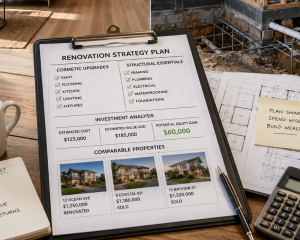
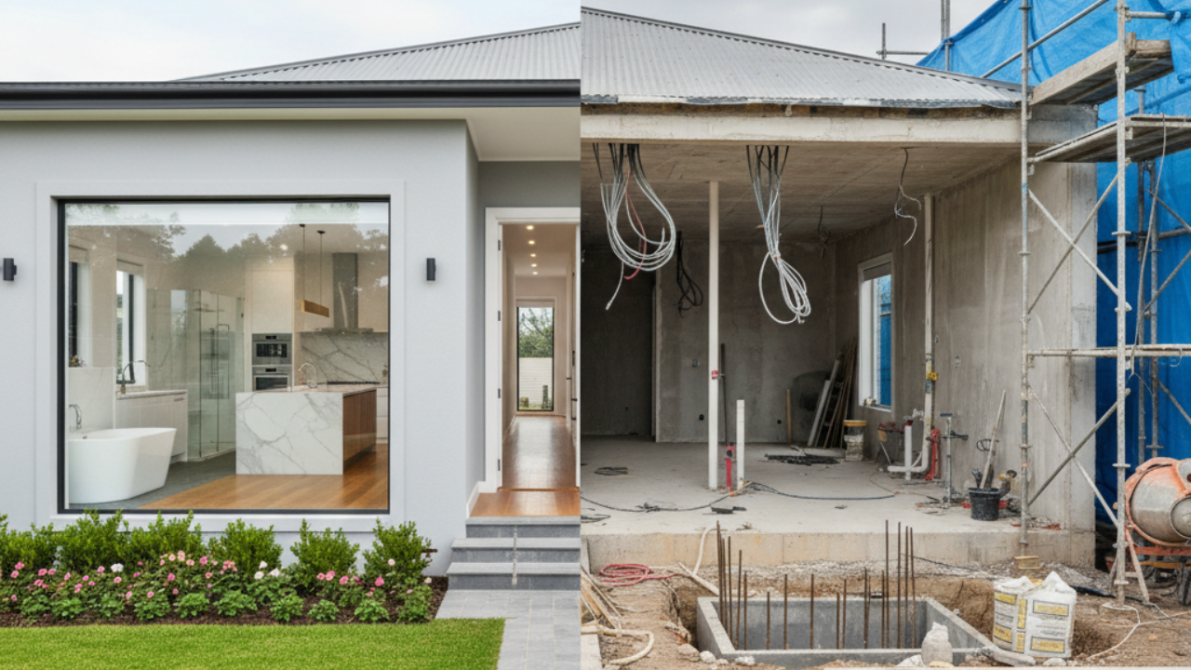
Cosmetic vs Structural Renovations: Which Adds More Value for Your Budget?
Key Takeaways
- Cosmetic renovations typically deliver 10-15% ROI, while structural work rarely returns dollar-for-dollar value.
- Buyers pay premiums for what they can see and feel immediately: kitchens, bathrooms, flooring and fresh paint.
- Structural work like roof repairs and foundation fixes is essential for safety but considered “table stakes” by buyers, it removes the discount rather than adds a premium.
- The smartest strategy is to address critical structural issues first, then invest heavily in cosmetic upgrades to manufacture equity.
- Understanding the difference between cosmetic and structural renovations helps you avoid overcapitalising and maximise equity gains.
You’ve got equity sitting in your property, a vision of what it could become, and a renovation budget that needs to stretch as far as possible. But here’s the dilemma keeping you awake at night: should you spend $30,000 on a stunning kitchen makeover that buyers will fall in love with, or invest that same amount replacing old plumbing and rewiring that nobody will ever see?
It’s not just about choosing between pretty and practical. It’s about understanding where your renovation dollar actually creates wealth. The difference between cosmetic vs structural renovations isn’t just semantic. It’s the difference between manufacturing equity and simply maintaining what you already own.
Most property owners and investors get this decision wrong. They either pour money into structural work expecting buyers to reward them with higher prices, or they ignore critical repairs and paint over problems that eventually cost them dearly. The result? Budget blowouts, overcapitalisation, and renovations that fail to add the value they desperately need.
Why This Decision Matters More Than You Think
Every dollar you spend on a renovation should be a strategic investment, not an emotional expense. Yet the Australian property market is littered with well-intentioned renovators who’ve sunk tens of thousands into their homes only to discover they’ve added minimal value when it comes time to sell or refinance.
The stakes are high. Get this right, and you can manufacture $50,000, $100,000, or even more in instant equity. Get it wrong, and you’ll join the countless renovators who’ve overcapitalised, spending more on improvements than the market is willing to pay back.
Here’s what makes this so frustrating: structural work feels important. It feels responsible. When a builder tells you the roof needs replacing or the foundations need underpinning, it triggers every sensible instinct you have. Of course you need to fix these things. But here’s the harsh truth that the property investment community has learned through decades of experience: buyers don’t pay premiums for structural work. They expect it to already be done.
Meanwhile, cosmetic renovations, the ones that might feel superficial or indulgent, are exactly where the money sits. A freshly painted home with quality timber flooring, a modern kitchen, and a renovated bathroom can sell for significantly more than an identical property with perfect bones but dated finishes.
The Hidden Cost of Getting Your Renovation Order Wrong
Think about it this way: you spend $30,000 replacing a roof. It’s essential work, it’s done properly, and your home is now weatherproof and safe. But when buyers walk through, they don’t see that new roof as added value. They see it as something that should already be there. You’ve spent $30,000 and received maybe $10,000-$15,000 in perceived value. That’s not a return on investment. That’s maintenance disguised as renovation.
Now imagine you spent that same $30,000 on cosmetic updates: fresh paint throughout, new flooring in the living areas, updated kitchen benchtops and splashback, and a bathroom refresh. Buyers walk in and immediately feel the difference. The property feels move-in ready. It feels valuable. Suddenly you’re not just getting your $30,000 back, you’re potentially adding $40,000-$45,000 to the property’s value.
This isn’t about ignoring structural problems. Far from it. But it is about understanding the strategic order of operations and where to allocate the bulk of your renovation budget to maximise returns.
What Makes Cosmetic Renovations So Powerful
Cosmetic renovations work because they target the emotional decision-making process that buyers go through. When someone walks into a property, they make snap judgements within the first 30 seconds. They’re not thinking about the age of the hot water system or whether the electrical wiring meets current standards. They’re feeling whether this home is “the one.”
According to insights from www.propertychat.ai, a platform built on over 20 years of renovation and property investment experience, cosmetic renovation wins hands down for bang for your buck. You’re not fixing problems that buyers expect to be solved anyway. You’re filling the pricing gap between an unrenovated property and a renovated one.
I’ve seen this play out in my own portfolio more times than I can count, but one project still makes me smile when I think about it. I had a small two-bedroom unit that needed work. Nothing structural was failing. The bones were solid. But the carpet was tired, the kitchen was dated, and the whole place felt like it had been frozen in time. I spent six weeks planning the renovation, which was actually longer than the renovation itself. The whole job took ten days. Paint throughout, new carpet, a full kitchen replacement, and curtains. Total spend: $14,000. When the valuation came back, the property was worth $100,000 more than it had been before we lifted a paintbrush. It was rented out before the tradies had even packed up and left.
That result wasn’t luck. It wasn’t a hot market doing the heavy lifting. It was the deliberate choice to put money exactly where buyers respond emotionally, into the things they see, touch, and feel the moment they walk through the door. Not self-expression (I’ve made that mistake too, four coats of white paint to cover a purple feature wall taught me that lesson well and truly). But renovation for the person who comes after you. Renovation designed to close the gap between what an unrenovated property is worth and what a renovated one commands. That gap is where equity lives.
The highest ROI home improvements consistently fall into cosmetic categories:
Kitchen Renovations: A modern, functional kitchen is the heart of most homes. Even a mid-range kitchen update with new benchtops, splashback, updated cabinetry hardware, and quality appliances can transform how a property presents. Buyers will pay significant premiums for a kitchen that looks and feels contemporary.
Bathroom Updates: Similar to kitchens, bathrooms drive emotional responses. Fresh tiling, modern fixtures, quality tapware, and good lighting can take a dated bathroom into the present day without requiring a full structural overhaul.
Flooring: Quality timber flooring or modern hybrid flooring throughout living spaces creates an immediate impression of quality and consistency. It’s one of the most cost-effective ways to lift the entire feel of a property.
Paint: Fresh, neutral paint is the ultimate cosmetic upgrade. It costs relatively little but delivers enormous perceived value. It makes everything else look better and signals to buyers that the property has been cared for.
Curb Appeal: Landscaping, a fresh front door, updated house numbers, and outdoor lighting, these elements create the critical first impression that determines whether buyers even want to step inside.
The Structural Renovation Reality Check: Costs vs Returns
Structural renovation costs in Australia can be eye-watering. Extensions, knocking down walls, raising roofs, replacing foundations, complete electrical rewiring, or comprehensive plumbing overhauls, these projects often run into tens of thousands of dollars, and sometimes well over $100,000.
Yet here’s the uncomfortable truth that experienced renovators have learned: structural work rarely adds value proportional to its cost. That doesn’t mean it’s not necessary. If you’ve bought a property with serious structural issues, you absolutely need to address them. But you need to do so with a clear-eyed understanding that you’re not creating premium value, you’re bringing the property up to baseline market expectations.
Does structural work add value to a house? Yes, but in a different way than most people assume. Structural work adds value by removing barriers to sale. A property with a failing roof, cracked foundations, or dangerous electrical wiring can’t sell for market price, it gets heavily discounted because buyers factor in the cost and hassle of fixing these problems themselves. When you fix structural issues, you’re not adding value so much as you’re removing the discount.
Think of structural work as defensive renovation and cosmetic work as offensive renovation. Structural keeps you in the game. Cosmetics wins the game.
How to Add Value to Your Home on a Budget
The smartest renovation strategy follows a clear sequence: identify any genuine structural issues, budget them as non-negotiable and keep them lean and functional, then invest the bulk of your renovation allowance in the spaces buyers see and touch.
This is where cheap cosmetic renovations shine. You don’t need to gold-plate everything. Mid-range finishes that present well and feel quality are often the sweet spot. You’re not renovating for yourself to live in for 20 years, you’re renovating to fill that gap between unrenovated and renovated pricing in your local market.
Here’s a practical framework to follow:
1. Due Diligence First. Get a comprehensive building and pest inspection. Understand what’s actually broken versus what’s just old. Not everything old needs replacing.
2. Fix What’s Genuinely Unsafe. Electrical issues, structural defects, roof leaks, serious plumbing problems, these need addressing. But keep the solutions functional and cost-effective. You’re not trying to impress anyone with your electrical panel.
3. Allocate the Majority to Cosmetics. Once structural safety is handled, pour your budget into the kitchen, bathroom, flooring, paint, and landscaping. This is where you manufacture equity.
4. Think Like a Buyer. What would make someone walk through this property and immediately want to put in an offer? What would make them feel like it’s move-in ready and worth paying a premium for?
The renovations that add the most value are almost always cosmetic because they directly influence buyer emotion and perceived value. Structural work supports this by ensuring the property can be sold without red flags, but it’s not where the profit sits.
Avoiding the Overcapitalising Trap
Overcapitalising on renovations is one of the biggest fears for property investors and renovators, and it’s absolutely justified. It happens when you spend more on improvements than the market will pay you back. It’s painfully common with structural work because the costs are high and the perceived value return is low.
Understanding renovation ROI means being ruthless about where each dollar goes. If you spend $50,000 on a structural extension but it only adds $30,000 to the property value, you’ve just lost $20,000 in equity. That’s overcapitalisation.
Conversely, if you spend $25,000 on cosmetic updates, paint, flooring, kitchen and bathroom refresh, and it adds $40,000 to the property value, you’ve manufactured $15,000 in instant equity. That’s the strategy that builds wealth.
The property investors who succeed long-term are disciplined about this distinction. They don’t fall in love with architectural visions or over-engineer solutions to structural problems. They identify the minimum viable structural work required, execute it efficiently, and then focus relentlessly on the cosmetic upgrades that deliver returns.
The Propertychat.ai Approach to Renovation Strategy
This isn’t guesswork or opinion. The renovation framework embedded into www.propertychat.ai has been developed over 20 years of hands-on property investing experience. It’s built around one core principle: cosmetic wins for ROI, and structural work is table stakes.
Propertychat.ai draws on decades of solid investing advice, mortgage expertise, and renovation knowledge, not current market data or financial predictions, but proven frameworks that work regardless of market cycles. The platform helps renovators and investors understand which renovations add value and which simply maintain it.
The book Your Property Success with Renovation walks through precisely this kind of decision-making process, covering the Trident Strategy, designed around low-risk, high-impact renovation choices. It’s about building a systematic approach that minimises risk and maximises equity growth through smart cosmetic investment layered on top of sound structural foundations.
Whether you’re researching your first renovation project or refining your strategy as an experienced investor, the discipline is in doing your due diligence upfront. Understand what’s genuinely broken versus what just needs refreshing, and then make strategic choices about where your renovation dollar goes.
Putting It All Together: Your Renovation Action Plan
So which is better for house flipping and equity building, cosmetic or structural renovations? The answer is both, but in the right order and with the right allocation.
Start with a thorough inspection to identify any critical structural issues. Budget these as necessary but non-negotiable expenses. Keep them lean. Don’t over-spec. You’re aiming for safe, functional, and meets code, not impressive.
Then shift your focus and the bulk of your budget to cosmetic upgrades. Kitchen, bathroom, flooring, paint, curb appeal. These are your equity generators. These are what buyers see, feel, and pay premiums for.
The pros and cons of cosmetic vs structural renovations come down to this: structural work protects your investment and ensures saleability, while cosmetic work creates value and drives returns. You need both, but the ratio matters enormously.
If you’re working with a limited renovation budget, and most people are, prioritise cosmetic work after addressing only the most critical structural issues. You’ll manufacture more equity, reduce your risk of overcapitalising, and create properties that buyers actively want to pay more for.
This is how smart renovators think. It’s not about what feels responsible or impressive. It’s about where the market assigns value and how you can capture that value most efficiently.
Whether you’re a first-time renovator, an experienced property investor, or somewhere in between, understanding this fundamental distinction between cosmetic and structural renovations will determine whether your project adds wealth or simply adds cost.
Ready to Renovate Smarter?
If you’re serious about using renovation to manufacture equity and build a property portfolio that works for you, the right guidance makes all the difference. Jane Slack-Smith and the team at Your Property Success have helped thousands of everyday Australians get their renovation strategy right, from the first inspection through to the final lick of paint.
Start with a free conversation at www.propertychat.ai and tap into over 20 years of proven renovation and investment knowledge, available any time you need it. Or explore the full Your Property Success mentoring programme to get personalised guidance tailored to your goals and your market.
Your next renovation project can be the one that genuinely moves the needle on your wealth. Make sure you go in with the right strategy.
Related Articles You Might Find Helpful
- How to Avoid Renovation Mistakes and Increase Profits – A practical Q&A covering the most common renovation pitfalls and how to avoid them.
- 10 Investment Strategies to Build a Property Portfolio in Australia – Expand your thinking beyond individual renovations and start building long-term portfolio wealth.
- 4 Biggest Mistakes You Can Make When Buying a Property to Renovate – Know what to look out for before you buy, so your renovation budget goes further.
- Preparing Your Home for Sale – Once your renovation is done, make sure your presentation strategy matches the effort you’ve put in.
- Real Life Renovation for Profit – See how real investors have applied these principles in the Australian market.
This article is provided in line with the Brand Voice of PropertyChat and Your Property Success, emphasising trust, actionable advice, and long-term partnership in property finance.
Transcript
Stop Overcapitalising: The Truth About Cosmetic vs Structural Renovations
0:00
All right, welcome to this explainer. If you are passionate about smart property investing and maximizing your returns, you’re in exactly the right place.
0:08
Today, we’re going to fundamentally shift how you look at property improvements. We’re going to break down exactly where your renovation dollars manufacture true wealth versus where
0:16
they’re just well maintaining a property you already own. Trust me, it’s an absolute gamecher for your portfolio.
0:22
So, the big question we’re tackling today is cosmetic versus structural renovations. which adds more value for your budget. Picture this. You’ve got a
0:31
$30,000 renovation budget. Do you drop that 30 grand on a stunning kitchen makeover that buyers are going to absolutely swoon over? Or do you sink
0:38
that exact same amount into replacing old plumbing and rewiring the house? You know, the stuff nobody will ever actually see. It’s a tough call, right?
0:46
But honestly, getting this choice wrong is the number one reason renovators lose money and completely miss out on massive equity gains. Okay, let’s look at our
0:55
road map for today. We’ll be covering one, the big renovation dilemma. Two, the structural reality check, three, why
1:03
cosmetic upgrades win, four, your smart renovation framework, and five, ready to renovate smarter. Let’s kick things off
1:13
with section one, the big renovation dilemma. Over capitalizing. This is literally the nightmare scenario for any
1:20
investor. You sink tens of thousands of dollars into a property, right? and you do it with the absolute best intentions.
1:26
But if you put that money into the wrong things, you just end up with these massive budget blowouts and zero added equity. And look, the Australian property market is just littered with
1:34
well-intentioned renovators who made this exact mistake, spending way more on improvements than the market is ever willing to pay back. Which brings us to
1:43
section two, the structural reality check. Let’s clearly contrast these two approaches. Think of structural renovations like your defensive moves.
1:52
Fixing cracked foundations, rewiring, they’re absolutely crucial for safety, and sure, they remove the discount a buyer would otherwise demand, but honestly, they’re just table stakes.
2:02
Cosmetic renovations, on the other hand, are your offensive strategy. These are the visual, highly emotional upgrades that actually manufacture equity and slap a premium on your selling price.
2:12
Structural keeps you in the game, but cosmetic, cosmetic actually wins the game. This sums it up brilliantly.
2:18
Buyers don’t pay premiums for structural work. Think about it. If you spend $30,000 replacing a roof, yeah, your house is weatherproof. Awesome. But when
2:27
buyers walk through, they don’t see that new roof is 30 grand of added value. They just see it as a basic requirement.
2:32
You might only get, say, $10 to $15,000 in perceived value back. That’s not a return on investment. That’s literally just maintenance disguised as a
2:39
renovation. Moving right along to section three. Why cosmetic upgrades win. Check out this number, 15%.
2:48
Cosmetic renovations typically deliver a 10 to 15% return on investment and sometimes much more. Why is that?
2:57
Because they target the snap emotional judgments that buyers make. When someone walks into a property, they’re deciding
3:04
if it’s the one in like the first 30 seconds. They aren’t thinking about the age of the hot water system. They’re reacting to how the space looks, how it
3:12
smells, and how it feels. Let me share this wild reallife anecdote from our source material to really put this into perspective. $100,000.
3:21
The author had this tired two-bedroom unit. Nothing structural was failing, but it was basically frozen in time.
3:28
They spent a super focused $14,000 over just 10 days. Paint, new carpet, a basic kitchen replacement, and curtains. And
3:36
when the valuation came back, the property was worth an incredible $100,000 more. That is not luck, folks.
3:42
That’s deliberately putting money exactly where buyers respond emotionally. So, where exactly does the smart money go? Here are the absolute highest ROI cosmetic categories.
3:52
Kitchens and bathrooms are huge. Even mid-range updates here drive massive emotional responses. Then you’ve got quality flooring and fresh neutral
4:00
paint. Paint is literally magic in a can. It costs relatively little, but delivers enormous perceived value. And finally, curb appeal and landscaping for
4:08
that crucial first impression. these specific categories. They would fill that massive pricing gap between an unrenovated property and one people are
4:16
fighting over. All right, section four, your smart renovation framework. Here is your four-step game plan based on the
4:24
Trident strategy to make sure you don’t overengineer things. Step one, due diligence first. Always, always get a comprehensive building and pest
4:32
inspection. You have to clearly understand what’s actually broken versus what’s just old. Step two, fix what’s unsafe. Handle the structural defects
4:40
and electrical issues, but keep the solutions lean. Nobody is impressed by a fancy electrical panel. Okay. Step three, allocate to cosmetics. Once
4:49
safety is handled, pour the vast majority of your budget into those highly visible cosmetic areas we just talked about. And step four, think like a buyer. Constantly ask yourself, what’s
4:58
going to make someone walk through this property and immediately want to put in an offer right now? And finally, section five, ready to renovate smarter. To wrap
5:07
up this explainer, I’ve got a challenge for you. It’s time to stop guessing with your renovation budget. If you’re serious about using renovations to
5:15
actually manufacture equity, you need the right guidance. Head over to property chat.ai to access Jane Slacksmith’s 20 plus years of proven
5:23
renovation frameworks. Stop leaving money on the table because the ultimate question you have to ask yourself before your next project is this. Are you just
5:32
going to maintain your property or are you finally ready to manufacture some real wealth? Thanks so much for joining me.
Frequently Asked Questions
What is the difference between cosmetic and structural renovations?
Cosmetic renovations focus on visual and surface-level improvements like painting, flooring, kitchen updates, bathroom refreshes, and landscaping. Structural renovations involve changes to the physical structure of a building, such as extensions, removing walls, foundation work, roof replacement, or major electrical and plumbing overhauls. Cosmetic work changes how a property looks and feels. Structural work changes how it functions and stands.
Do cosmetic renovations add more value than structural work?
Yes, typically cosmetic renovations deliver significantly higher return on investment, often 10-15% or more, because they directly influence buyer emotions and perceived value. Structural work is essential for safety and saleability but rarely returns dollar-for-dollar value because buyers expect these elements to already be in good condition. Cosmetic improvements fill the pricing gap between unrenovated and renovated properties, while structural work brings properties up to baseline market expectations.
How can I avoid overcapitalizing on renovation projects?
Avoid overcapitalising by understanding your local market’s price ceiling, identifying only critical structural issues that genuinely affect safety and saleability, and allocating the majority of your budget to high-impact cosmetic upgrades. Get a professional building and pest inspection early, keep structural solutions functional rather than premium, and focus renovation spending on the areas buyers see and value most, kitchens, bathrooms, flooring, paint, and curb appeal. Always ask whether each renovation dollar will be returned by the market.
Which renovations give the best ROI for property investors in Australia?
The highest ROI renovations for Australian property investors are typically kitchen and bathroom updates, quality flooring installation, fresh neutral paint throughout, and improved curb appeal through landscaping and external presentation. These cosmetic improvements consistently deliver strong returns because they create immediate emotional responses in buyers and make properties feel move-in ready. Structural work should be limited to only what is essential for safety and building compliance.