What Is the Difference Between a Flat Fee and Percentage-Based Buyers Agent?
Key Takeaways:
- Flat fee buyers agents charge a fixed amount regardless of purchase price, aligning their incentives with securing you the best deal rather than the highest price.
- Percentage-based models typically charge 1.5% to 3% of the purchase price, which can create a potential conflict of interest as the agent earns more when you pay more.
- For buy-and-hold investors, flat fee structures generally offer cleaner alignment, eliminating the incentive to push toward higher-priced properties.
- Transparency in fee agreements is essential, know exactly what you’re paying upfront and ensure your solicitor reviews all terms before signing.
When you’re about to commit tens of thousands of dollars to professional property advice, understanding exactly how your buyers agent gets paid isn’t just smart, it’s essential. The fee structure your agent uses doesn’t just determine what lands on your invoice. It shapes every recommendation they make, every suburb they suggest, and every negotiation strategy they deploy.
Most Australian property investors assume all buyers agents work the same way. They don’t. Two agents with identical experience, working in the same city, can charge in completely different ways. One might collect a percentage of whatever you pay for the property. The other charges a fixed amount whether you buy at $450,000 or $650,000. That difference matters more than most buyers realise.
The challenge isn’t just picking the cheaper option. It’s understanding where your agent’s financial incentives sit, and whether those incentives align with yours. When you’re negotiating on a property listed at $550,000, does your agent benefit if you settle at $520,000? Or do they make more money if you pay the full asking price?
How Are Buyers Agents Paid in Australia?
Understanding how buyers agents are paid is the foundation of any good engagement decision. There are two primary fee models used across Australia, the percentage (commission) model and the flat fee (fixed) model. Each works differently, and each has different implications for where your agent’s incentives actually sit.
The Percentage (Commission) Model
The percentage model ties the agent’s fee directly to your purchase price. If you buy a property for $500,000 and the agent charges 1.5%, you pay $7,500. If the same property settles at $550,000, that fee jumps to $8,250. The agent earns $750 more for every $50,000 increase in purchase price.
According to industry data from REBAA, typical buyers agent commission rates across Australia range from 1.5% to 3% plus GST, with variations depending on location and service scope.
Here is where the buyers agent conflict of interest becomes a real concern. Your buyers agent is supposed to negotiate the price down on your behalf. But in a percentage model, every dollar they shave off the purchase price reduces their own fee. That creates a built-in tension. The agent might still negotiate hard, many do, but the financial incentive pulls in the opposite direction to your goal.
The Flat Fee (Fixed) Model
The flat fee model works differently. You agree on a fixed dollar amount upfront, say $12,000, and that is what you pay regardless of the final purchase price. Whether you secure the property at $450,000 or $650,000, the agent’s fee stays the same. That shifts the incentive completely. The agent isn’t chasing percentage points. They’re focused on finding you a genuinely good property that meets your criteria and negotiating the best possible price, because their fee doesn’t change either way.
Most fixed fee buyers agents in Australia charge between $8,000 and $30,000 depending on experience, location and scope of work. Entry-level agents building their client base tend to sit at the lower end. Experienced agents with hundreds of transactions under their belt charge toward the top of that range. The fee typically reflects not just hours worked, but depth of market knowledge, strength of off-market networks, and proven negotiation outcomes.
PropertyChat.ai, built on over 20 years of solid investing, mortgage and renovation advice, addresses this structural tension head-on. The platform, available at www.propertychat.ai, helps investors understand buyers agent fee structures and make informed decisions before signing any agreement.
The Conflict of Interest Problem with Percentage-Based Buyers Agent Fees
From a buy-and-hold investor’s perspective, the buyers agent conflict of interest inherent in percentage-based models is worth examining closely. The agent has a built-in motivation to push you toward a higher price, even when you’ve found a good deal at a lower figure. Their paycheck grows with the purchase price, full stop.
I’ve seen this play out with my own clients over many years. I’ve spoken about this exact tension on my podcast, the fact that a good buyers agent fee often more than pays for itself through powerful negotiation, but only when the incentive structure is clean. One client I worked with had been using a percentage-based agent and couldn’t understand why, despite the market softening, the agent kept steering her toward properties at the top of her budget. The maths were simple once we looked at it together. Every extra dollar she spent added to his fee. She wasn’t getting bad advice because her agent was dishonest. She was getting skewed advice because the fee model made it rational for him to behave that way. When she switched to working with a flat fee agent the following year, the dynamic shifted immediately. He came back to her with a property $40,000 under what she’d expected to pay, because finding her something genuinely good at the right price was the whole point of his work. His fee didn’t change either way. That is the difference in practice. It’s not about trusting one type of agent and distrusting another. It’s about understanding where someone’s financial incentive sits before you hand them the keys to one of the biggest decisions of your financial life. And once you understand that, the fee structure conversation stops being about cost and starts being about alignment.
A flat fee buyers agent model changes the dynamic entirely. You pay a fixed amount, say $12,000, regardless of whether you buy at $450,000 or $650,000. The agent gets the same fee either way. Their incentive shifts away from inflating the price and toward getting you a genuinely good property that meets your criteria. They’re not chasing percentage points; they’re focused on doing solid work for a set amount.
Flat fee agents tend to work best when you’ve done your homework first. They excel with investors who come prepared with clear criteria, suburb research already completed, and a solid understanding of what they’re looking for. A percentage-based agent might justify their model by saying they have skin in the game, they earn more by closing a deal at any price. But that’s exactly the conflict you want to avoid.
Buyers Agent Fee Structure Australia: What to Look for in Your Agreement
What matters most in your agreement with either model is clarity, fixed term, clear exit clauses, and performance checkpoints. Have your solicitor review whatever you sign. Look for details on what’s included in the fee and what sits outside it. Most buyers agents cover strategy sessions, suburb research, property inspections, due diligence coordination, and negotiation. But third-party costs like building and pest reports ($500 to $800), strata reports ($200 to $600), and conveyancing ($1,200 to $2,500) typically sit outside the agent’s fee.
Ask upfront whether the quoted fee includes GST. All registered buyers agents charge GST on their services, but some quote inclusive and others exclusive. A $15,000 fee becomes $16,500 once GST is added. That’s not a small difference when you’re budgeting for acquisition costs.
Engagement fees, the upfront retainer you pay to begin the search, typically range from $3,000 to $10,000. Most agents deduct this from the total fee at settlement, so it’s not additional money, just paid earlier. The engagement fee covers initial research and filters for serious buyers, ensuring the agent can invest proper time in your search rather than juggling dozens of half-committed clients.
Flat Fee vs Percentage: A Real-World Cost Comparison
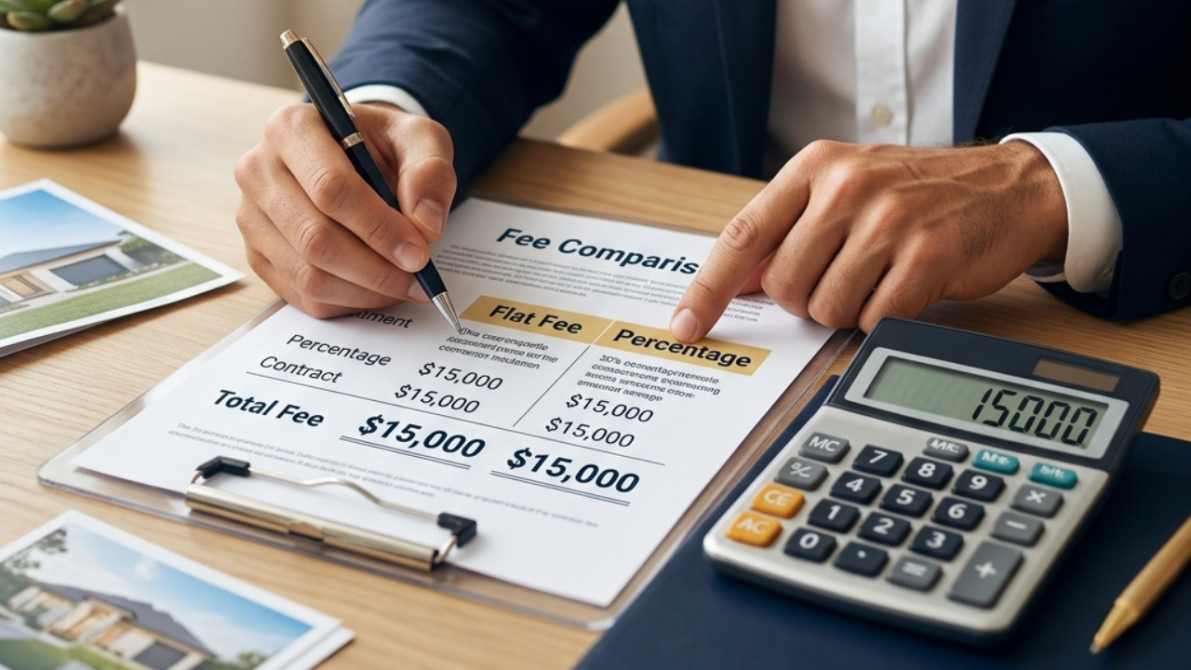
Let’s run the numbers on a typical Brisbane investment property with a $600,000 budget. Under a buyers agent percentage fee model at 2%, you’d pay $12,000 if you purchase at $600,000. But if the property settles at $650,000 because the market moved or the agent didn’t negotiate aggressively, your fee jumps to $13,000.
Under a flat fee buyers agent model at $12,000, you pay that amount whether the property comes in at $550,000 or $650,000. If your agent negotiates the price down from $600,000 to $570,000, a realistic outcome based on comparable sales and building inspection findings, you’ve saved $30,000 on the purchase price while your agent’s fee stayed fixed. That’s genuine alignment.
According to data from property research platforms, buyers working with agents secure properties roughly 2% to 5% below comparable sales when negotiation is handled professionally and emotion is removed from the process. On a $600,000 property, that’s $12,000 to $30,000 in savings, often enough to cover the buyers agent fee entirely.
Questions to Ask Before You Sign a Buyers Agent Agreement
Before engaging any buyers agent, regardless of fee model, ask these questions:
Does your fee change if you negotiate the price down by $50,000? If yes, you’re dealing with a percentage model. If not, it’s fixed.
What’s included in your fee, and what costs sit outside it? Get a written breakdown of every line item.
How many properties have you personally transacted on? Experience matters. An agent who has completed five deals has a very different network and negotiation track record than one who has completed 500.
Do you take commissions from developers or selling agents? If they do, the shortlist they present isn’t truly independent.
Can I see recent case studies with actual purchase prices versus list prices? Testimonials are nice. Hard numbers are better.
Tax Treatment and Long-Term Considerations
For investment properties, buyers agent fees typically form part of the property’s cost base for capital gains tax purposes. That means the fee reduces your taxable gain when you eventually sell, rather than providing an immediate tax deduction. For owner-occupied purchases, the fee isn’t deductible at all. Always confirm the treatment with your accountant based on your specific ownership structure and investment entity.
The long-term value of a buyers agent isn’t just the negotiation saving on day one. It’s selecting the right property in the first place. A property chosen based on data-driven suburb research and solid fundamentals will outperform one bought on gut feel or emotional attachment. That performance gap compounds over a 10-year hold, potentially adding tens of thousands in equity growth that far exceeds the upfront fee.
Making Your Decision: Flat Fee vs Commission Buyers Agent
The flat fee versus percentage question ultimately comes down to alignment. Do you want an agent whose financial outcome improves when you pay more? Or do you want an agent whose fee stays the same regardless, removing the incentive to let the price creep up?
For serious buy-and-hold investors building long-term portfolios, flat fee structures offer cleaner alignment and more predictable costs. For buyers with flexible budgets who want their agent focused on value rather than commission, fixed fee buyers agents in Australia make strategic sense.
Whatever model you choose, read the engagement agreement carefully. Understand what you’re paying, when you’re paying it, and what happens if the purchase falls through. Have your solicitor review the terms. And make sure you’re working with an agent who has a proven track record of securing properties below market value, because that’s where the real return on your investment sits.
Ready to make a more informed decision about buyers agent fee structures? Explore the insights, tools and expert guidance available at www.propertychat.ai,built on 20 years of proven investing, mortgage and renovation experience, not current market spruiking. Ask our AI anything, anytime.
Related Articles from PropertyChat.ai
Looking to go deeper on buyers agents and property investment strategy? These articles are worth reading next:
- What Does It Cost to Hire a Buyers Agent in Australia? The Complete 2025 Guide
- How to Choose a Buyers Agent: What Makes the Best Stand Out in Australia
- Is a Buyers Agent Worth It? First Home Buyer vs Investor Guide
- Essential Questions to Ask Before Hiring a Buyers Agent: Your Complete Guide
- Mortgage Broker Commission Structures: Key Differences 2026 – for context on how commission structures work across the property services industry
This article is provided in line with the Brand Voice of PropertyChat and Your Property Success, emphasising trust, actionable advice, and long-term partnership in property finance.
Transcript
Flat Fee vs Commission. Which Costs Less
0:00
Welcome back everyone to this explainer.
0:03
Today we’re diving straight into a critical yet honestly frequently overlooked topic in property investing.
0:10
We’re looking at exactly how the way you pay your buyer’s agent directly shapes the advice they give you. Specifically, what’s the real difference between a
0:18
percentage-based and a flat fee buyer agent model? When you’re dropping tens of thousands of dollars for professional property advice, understanding how your agent gets paid isn’t just a smart move.
0:27
It’s absolutely essential. The fee structure doesn’t just dictate your invoice, it literally shapes every suburb they suggest and every
0:35
negotiation strategy they deploy. So, let’s follow the money. But before we get into the actual mechanics of those fee structures, here’s a question for
0:43
you. Does your property agent actually want you to pay less? It’s kind of a provocative question, right? I mean, we hire professionals to get us the best
0:51
possible deal, but what if the true financial motives of the person you hired are completely at odds with your own? It’s a bit jarring to think about,
0:58
but for sure it is the reality for many property buyers out there today. Section one, how buyer agents get paid. Because to truly understand an agent’s advice,
1:07
we first have to understand their paycheck. Okay, so there are two primary models used across Australia and they have vastly different implications for
1:15
you as the buyer. The first one is the percentage or commission model. Under this structure, your agents fee is tied directly to your final purchase price.
1:24
This means the fee scales up or down based on what you ultimately pay for the home. Think of it like this. If you buy a property for $500,000, you pay one
1:31
fee. But if that exact same property settles at $550,000, your fee jumps up.
1:36
Basically, the agent earns more money for every single increase in the purchase price. So, what does that actually look like in the real world?
1:44
Well, according to industry data from REBA, typical buyer agent commission rates across Australia range from 1.5% to 3% of the purchase price plus GST.
1:53
Now, this can obviously vary depending on the location and the exact scope of their services, but this is your standard benchmark if you’re engaging a
2:01
percentage-based agent. Now, the primary alternative to that is the flat fee or fixed model. This is simply an agreed upfront fixed dollar amount paid to the
2:10
agent completely regardless of the final purchase price. Whether you secure the property at $450,000 or $650,000, the agent’s fee stays exactly the same.
2:19
Your cost is 100% locked in before the property search even begins. In Australia, most fixed fee buyers agents charge somewhere between $8,000 and
2:29
$30,000. Now, you’re probably wondering why there’s such a massive range there.
2:33
Basically, that variation scales based on the agents experience, the depth of their market knowledge, the strength of their offmarket network, and you know, their proven negotiation outcomes.
2:42
Entry-level agents sit at the lower end, while highly experienced agents are at the top. But crucially, this fee reflects their expertise and scope of
2:50
work, not the price tag of the property you end up buying. Section two, the commission conflict. Okay, let’s dive
2:59
into this. This is where things get incredibly fascinating because there’s a massive almost hidden psychological tension within the percentage model.
3:08
Look at it this way. Your goal as the buyer is to secure the absolute lowest possible property price, right? But your
3:15
percentage agents incentive is to secure a higher property price because, well, it yields a larger fee for them. Your buyer’s agent is supposed to negotiate
3:23
the price down on your behalf. But in a percentage model, every single dollar they shave off the purchase price actively reduces their own paycheck. The
3:31
financial incentive is literally pulling in the exact opposite direction of your goal. To really put this into perspective, let me share a real world
3:39
anecdote from our source material. There was a client working with a percentage-based agent and she just couldn’t understand why despite a
3:47
softening market, her agent kept steering her toward properties at the very top of her budget. When they finally looked at the math, it became glaringly obvious. Every extra dollar
3:56
she spent added to his fee. She wasn’t necessarily getting malicious or dishonest advice, but she was definitely getting skewed advice. The fee model
4:04
simply made it completely rational for the agent to behave that way. Which brings us to section three, the flat fee
4:11
advantage. For serious investors, especially those looking to buy and hold, this flat fee model is often the
4:18
absolute gamecher. It’s the solution for getting professional advice that is entirely untainted by commission
4:25
scaling. Under a flat fee model, the incentive shifts completely away from inflating the price and squarely towards securing a genuinely good property.
4:34
Because a flat fee agent makes the exact same amount either way, their motivation aligns 100% with finding you the right deal. They aren’t chasing percentage
4:43
points. that focused entirely on doing solid work, meeting your criteria, and negotiating the absolute best price for you. Moving right along to section four,
4:52
a real world cost comparison. Let’s actually run the numbers on a hypothetical investment property in Brisbane, just to see these financial
5:00
outcomes side by side. Let’s assume you’ve got a $600,000 budget. If the market moves or the agent maybe just doesn’t negotiate aggressively and the
5:08
property settles at $650,000, a 2%age agent gets $13,000. Meanwhile, the flat fee agent gets their agreed $12,000.
5:17
But here’s the really wild what if scenario. What if your agent does an incredible job and negotiates the price way down to $570,000?
5:25
Well, the fixed fee stays at $12,000, but the percentage agents fee drops to $11,400.
5:31
Yes, you heard that right. The percentage agent literally loses money for doing a great job for you. And what’s really interesting here is that $30,000 figure. By negotiating the price
5:40
down from your $600,000 budget to $570,000, which by the way is a very realistic outcome based on comparable sales and professional negotiation, you’ve
5:48
essentially saved $30,000 on the purchase price. That $30,000 easily covers the flat fee entirely. It just completely proves the immense value of
5:56
having a professional whose financial incentives are perfectly aligned with yours. Section five, protecting your next purchase. Let’s talk about vetting
6:03
your agent. So, knowing the difference between these models is great, but you also really need to know what to watch out for before you actually hand over
6:11
your hard-earned money. Here are the essential vetting questions you absolutely must ask. Number one, does your fee change if you negotiate the price down? If yes, obviously it’s a
6:20
percentage model. Number two, are all costs included? Make sure you get a written breakdown. Number three, do you take developer commissions? Guys, this
6:27
is a massive red flag. If they do, the short list of properties they present to you simply isn’t truly independent. And finally, what is your transaction experience? An agent who’s done five
6:36
deals has a wildly different network than one who’s done 500. You also really need to look out for hidden contract traps. For instance, always ask if the
6:45
quoted fee includes GST. I mean, a $15,000 fee quickly becomes $16,500 once GST is slapped on there. Also, be aware
6:54
of engagement fees. These are upfront retainers, typically ranging from $3 to $10,000 just to begin the search. And
7:01
remember that third party costs, things like building and pest reports, strata reports, and conveyancing, those almost always sit completely outside the
7:08
agent’s fee. Oh, and here’s a quick super useful tax tip straight from our source material. For investment properties, buyer’s agent fees typically
7:17
form part of the property’s cost base for capital gains tax purposes. They’re actually not an immediate deduction against your rental income. Instead,
7:25
they reduce your taxable gain when you eventually go to sell. So, selecting the right property with an aligned agent can really compound that value over, say, a
7:33
10-year hold, adding tens of thousands in equity growth that far, far exceeds that initial upfront fee. Section six,
7:40
making an aligned decision. We’ve covered the fundamental differences, the inherent conflicts, and the real world numbers. Now, it’s all about empowering
7:49
your final choice. I want to leave you with this provocative thought. The fee structure conversation isn’t just about cost. It’s entirely about alignment. Ask
7:58
yourself, do you want an agent whose financial outcome improves when you pay more, or do you want a professional whose fee stays exactly the same,
8:06
completely removing the incentive to let the price creep up? At the end of the day, you want an agent whose financial outcome improves your own, not the other
8:13
way around. If you’re ready to make a truly informed and aligned decision about your next property purchase, I highly urge you to visit property
8:20
chat.ai. That’s https colin/propy chat.ai. There you can ask the AI
8:28
absolutely anything and access over 20 years of proven investing tools, mortgage insights, and expert guidance.
8:35
Please don’t leave your largest financial decisions to chance or worse to conflicting incentives. Head over to property chat.ai right now. Thank you so much for joining me for this explainer.
8:45
As you plan your next move, just ask yourself, whose bottom line is your professional really protecting? Happy investing.
Frequently Asked Questions
Is a flat fee buyers agent better than a commission-based one?
For most property investors, yes. Flat fee models remove the conflict of interest inherent in percentage-based commissions. When your agent’s fee doesn’t change with the purchase price, they have no financial incentive to push you toward higher-priced properties or to accept a higher offer during negotiations. That said, the quality and experience of the individual agent matters more than the fee structure alone. A highly skilled percentage-based agent may still deliver better results than an inexperienced flat fee agent.
Are buyers agent fees tax deductible in Australia?
For investment properties, buyers agent fees form part of the property’s cost base for capital gains tax purposes. This means the fee reduces your taxable capital gain when you sell, but it is not immediately deductible against your rental income. For owner-occupied properties, buyers agent fees are not tax deductible at all. The Australian Taxation Office treats them as a capital cost of acquisition. Always consult your accountant or tax adviser for advice specific to your situation and ownership structure.
Can I negotiate buyers agent fees?
Yes, fees are negotiable in most cases. However, be cautious about agents who discount heavily without explanation. Experienced buyers agents with strong track records rarely need to discount because their negotiated savings and results justify their fees. A heavily discounted fee might signal a lack of experience, a high-volume low-touch service, or a narrower scope of work. Focus on the value delivered and the agent’s proven track record rather than the lowest headline fee.
What should I do if my buyers agent recommends a property I’m unsure about?
Ask specific questions about why they’ve recommended it. Request comparable sales data, rental yield analysis, and growth projections for the suburb. A good buyers agent will walk you through their reasoning with data, not emotion. If their recommendation doesn’t align with your investment criteria or risk tolerance, say so clearly. You’re the client, and the final decision is always yours. If the agent pressures you or can’t back up their recommendation with solid research, that’s a red flag worth noting.