
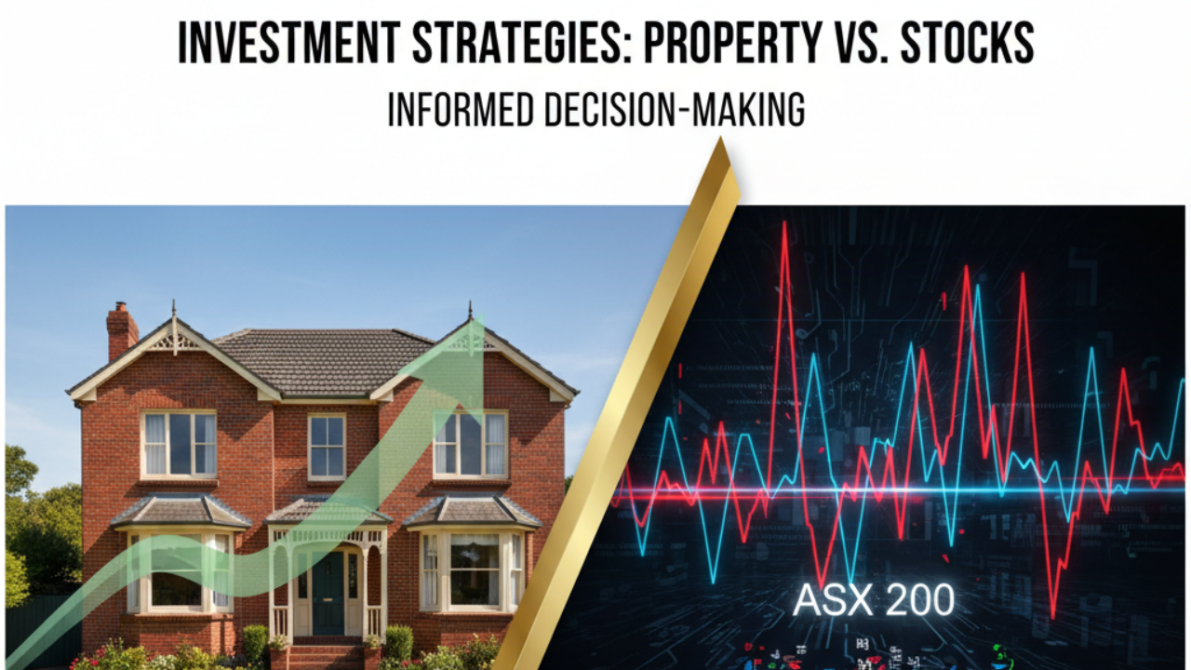
Is Property Investment Safer Than Shares or the Stock Market?
Key Takeaways:
- Property investment generally offers lower volatility than shares based on 20+ years of market evidence
- Australian dwelling values showed less volatility compared to the ASX 200, particularly during market downturns like the GFC
- Property provides tangible assets with rental income streams, while shares depend on company performance
- Gearing opportunities in property can amplify returns, with 90% of homes worth more than their original purchase price
- Both investment types carry risks, property is illiquid and has holding costs, while shares face market volatility and disruption risks
When you’re standing at the crossroads of building wealth, you’ve probably asked yourself this crucial question: Is property investment safer than shares or the stock market? You’re not alone. Every week, thousands of Australians grapple with this decision, feeling overwhelmed by conflicting advice and concerned about making the wrong choice with their hard-earned money.
The pressure to choose correctly is immense. Your financial future, your family’s security, and your retirement dreams all hang in the balance. One wrong move could set you back years, or worse, leave you watching from the sidelines as others build the wealth you desperately want.
But here’s the reality based on two decades of property investment experience and market analysis: property investment does tend to be safer than shares or the stock market, though both carry their own unique risks and rewards. Let me break down exactly why, with the facts and figures that matter.
The Volatility Reality Check
When we talk about safety in investing, we’re really talking about volatility, how much your investment swings up and down. The evidence is clear: property consistently shows less dramatic price movements than shares.
During the Global Financial Crisis, while the ASX 200 “tanked hard,” dwelling values showed significantly less volatility overall. The black line of the share index told a story of dramatic crashes and recoveries, while property markets dipped moderately and bounced back with considerably less drama.
This isn’t just a one-off event. Historical data since 1990 shows that median capital returns for property owners hit 7.8% per year, with over 90% of homes worth more than when they were bought. Compare this to the wild swings we see in share markets, where tech disruption can eliminate entire companies overnight.
When I think back to my own start in property investment, I’m reminded just how real the emotional rollercoaster can be. I bought my very first unit right in the shadow of the Global Financial Crisis. At the time, friends warned me I was making a mistake, “Why not wait?” “Isn’t everything about to fall apart?”, and frankly, those headlines did weigh on my mind. But instead of following the market noise, I focused on the fundamentals: a solid location, walkable to public transport, and genuine demand from local renters. Even when share markets nose-dived and everyone seemed to be panic-selling, that modest unit kept attracting tenants and slowly appreciating. Looking back now, it’s clear that having a tangible, rental-producing asset helped me sleep at night, despite all the broader chaos. It’s a lesson I never forgot: while markets swing, well-chosen property tends to weather the storms far better than most people expect. And sometimes, the most important part of investing isn’t the numbers, it’s trusting your research and having the grit to hold steady when everyone else doubts.
The Tangible Asset Advantage
Property investment offers something shares simply can’t: tangible assets you can see, touch, and physically inspect. When you buy property, you’re purchasing bricks and mortar with real rental income flowing in regularly. This creates a foundation of stability that paper assets struggle to match.
With shares, you’re essentially betting on company performance in an increasingly unpredictable business landscape. Consider this sobering statistic: studies predict that 40-50% of S&P 500 companies could disappear within the next 10 years. Think about once-dominant companies like Kodak, or how Uber disrupted the entire taxi industry virtually overnight.
Your share portfolio might include companies that won’t exist in a decade, but well-located property in established suburbs tends to endure and appreciate regardless of technological disruption.
The Gearing Game-Changer
Here’s where property investment really shines: the ability to use leverage effectively. Drop $80,000 on a $400,000 property that grows 10%, and your return jumps to 50% on your actual cash invested. This mathematical advantage is much harder to achieve safely with shares.
Banks are generally more willing to lend against property than shares because they understand the underlying asset. They know that even in tough times, people need homes, and well-located property retains intrinsic value. This makes property investment more accessible to everyday Australians who want to build wealth without requiring massive upfront capital.
Income Streams That Actually Flow
Rental income provides a steady cash flow that helps cover holding costs, unlike share dividends that can vanish during tough times. Even during market downturns, people still need places to live, which means rental income tends to be more reliable than dividend payments.
This steady income stream becomes particularly valuable during periods of economic uncertainty. While companies might slash dividends to preserve cash during challenging times, rental properties continue generating income that can help service loans and provide cash flow.
The Wealth-Building Track Record
The statistics don’t lie about property’s wealth-building potential. Of Australia’s richest individuals, 72 out of the top 187 made or hold their wealth in property. This isn’t coincidence, it’s evidence of property’s proven ability to create and preserve wealth over time.
Since 1990, the consistent performance of property markets has created wealth for ordinary Australians who followed sound investment principles. These aren’t get-rich-quick stories, but steady wealth accumulation over 7-10 year holding periods.
Understanding the Risks of Property Investment
However, let’s be completely honest about property’s limitations. Property investment isn’t risk-free, and anyone telling you otherwise is doing you a disservice.
Property is illiquid, you can’t sell overnight like shares. If you need access to your capital quickly, property can leave you stuck. Additionally, you’ll face holding costs like maintenance, rates, and insurance, typically running 1-2% per annum.
Market timing matters too. Buy in the wrong area or at the wrong time, and you might face years of stagnant growth or, in extreme cases, capital loss.
The Share Market Reality
Shares might feel “diversified,” but one bad picking decision can tank your entire portfolio. While professional fund managers work full-time analysing companies, retail investors often make emotional decisions or follow hot tips that lead to losses.
The pace of change in business has accelerated dramatically. What seems like a solid company today might be obsolete tomorrow due to technological disruption, regulatory changes, or shifting consumer preferences.
Location, Location, Location Still Matters
In property investment, success largely comes down to buying the right property in the right location. This means focusing on:
- Established suburbs with strong fundamentals
- Areas with diverse employment opportunities
- Locations with good transport links and amenities
- Property types that appeal to the broadest tenant base
With shares, even perfect research can’t protect you from unexpected disruption or management decisions beyond your control.
Your Investment Timeline Matters
Property investment works best for those thinking in 7-10 year timeframes, not day-trading mentalities. This longer-term approach allows you to ride out market cycles and benefit from compound growth.
If you need liquidity or want to actively trade, shares might suit your strategy better. But if you’re building long-term wealth and can commit to holding periods, property’s stability becomes a significant advantage.
Due Diligence Is Non-Negotiable
Regardless of whether you choose property or shares, success depends on thorough research. With property, this means analysing suburb fundamentals, understanding rental yields, and calculating all costs accurately.
The key difference is that property due diligence, while extensive, focuses on tangible factors you can verify. Share analysis involves predicting future business performance in rapidly changing markets, a considerably more challenging task.
Making Your Investment Choice
Your personal circumstances should drive your decision. Consider your:
- Risk tolerance and sleep-at-night factor
- Available capital and borrowing capacity
- Time horizon for investments
- Need for liquidity
- Ability to manage properties or research shares
Neither property nor shares guarantee success, but property’s historical stability, tangible nature, and wealth-building track record make it the safer choice for most long-term investors.
The evidence from 20+ years of market observation consistently points to property as the more stable wealth-building vehicle. While shares might offer quick gains, property delivers steady, compound growth that has created more Australian millionaires than any other investment class.
Remember, this represents general market observations based on historical performance, not personal financial advice. Your individual circumstances matter enormously in determining the right investment strategy for you.
The insights in this article come from PropertyChat.ai, drawing on 20+ years of property investment experience and research. PropertyChat.ai provides general information and guidance but does not offer real-time market data, specific property prices, or personal financial advice. Always consult with qualified professionals before making investment decisions.
Related Articles
Positive vs Negative Gearing: Key Differences Explained
Property Investment vs Shares & Managed Funds: 2026 Comparison Guide
How to Avoid Buying the Wrong Property and Losing Money: Essential Australian Investment Guide
Property vs Shares: Which is Better for Long-Term Wealth?
This article is provided in line with the Brand Voice of PropertyChat and Your Property Success, emphasising trust, actionable advice, and long-term partnership in property finance.
Transcript
Property vs Shares: Which Actually Protects Your Wealth?
0:00All right, let’s get right into it.
0:01We’re tackling a massive question today.
0:04One that could literally define your
0:05financial future when it comes to
0:07building real long-term wealth. Which is
0:09the safer bet? Property or the stock
0:12market? And you know, this isn’t just
0:14about spreadsheets and numbers. This is
0:16a deeply personal decision, right? It’s
0:18about where you put your hard-earned
0:20money. And it can feel like everyone has
0:22a different opinion. So, let’s try to
0:24cut through some of that noise. I mean,
0:26we’re talking about your financial
0:27future, your family security, even your
0:29retirement dreams. They all kind of hang
0:31in the balance with this decision. So,
0:33the pressure is on. What is over two
0:35decades of market analysis actually tell
0:37us about the safer path? Okay, so first
0:40things first, to even begin to answer
0:42which is safer, we really have to agree
0:43on what safety even means when we’re
0:45talking about investing. And for most
0:47people, it really boils down to one key
0:49word, volatility.
0:51So, what’s volatility? Well, it’s just
0:54how much the value of your investment
0:55jumps up and down. And when you look at
0:57the data from over the years, there’s a
0:59really clear difference. Property, it
1:01tends to be a much smoother ride. You
1:03know, fewer hearts stopping drops. The
1:05stock market, on the other hand, can be
1:07a total roller coaster. And for a lot of
1:09investors, that smoothness, that’s what
1:12feels like safety. But, you know, theory
1:14is one thing. What happens when these
1:16two investments get put through a
1:18realworld stress test? And honestly,
1:20there’s no better test case than the
1:21global financial crisis. It was one of
1:23the biggest financial shocks in modern
1:25history. During the GFC, the stock
1:28market’s reaction was, well, brutal. The
1:31Aussie market, the ASX 200, it just
1:34tanked hard. We saw the index just
1:36plummet and so many people watched their
1:38portfolios get slashed almost overnight.
1:41And the climb back, it was a long, bumpy
1:43road for sure. And this is where you
1:46really see the contrast. While property
1:48values did take a hit, I mean, let’s be
1:50real, they weren’t immune. The dip was
1:52so much more moderate, the bounceback
1:54had far less drama. It just didn’t have
1:56that same level of sheer panic and wild
1:58volatility we saw in the share market.
2:01And look, this isn’t just some abstract
2:03chart. The author of the source material
2:05actually shared a personal story about
2:07this. They bought their first property
2:09right in the thick of the GFC. Can you
2:11imagine? Friends were telling them they
2:13were making a huge mistake, but they
2:14held their nerve. So, what was the big
2:16lesson from that experience? It really
2:19comes down to these three things. One,
2:21focus on the fundamentals. You know, the
2:23actual location, real demand from
2:25tenants. Two, learn to ignore all the
2:27market noise, and the scary headlines.
2:29And three, trust the research you’ve
2:31done and just hold steady. All right,
2:33let’s switch gears a bit and talk about
2:35property’s tangible advantages. The very
2:38nature of these assets creates some
2:40pretty unique benefits, and it all
2:41starts with what you can actually hold
2:43in your hand. Think about it. Property
2:45is real. It’s bricks and mortar that you
2:48can see and touch. It provides something
2:50people will always need, a roof over
2:52their heads. That tangibility gives it
2:54this inherent stability. Now, shares are
2:57different. They’re intangible, sure, but
2:59they represent ownership in some of the
3:01most innovative companies out there,
3:02which offers a whole different kind of
3:04potential for growth. Now, speaking of
3:06those companies, here’s a statistic from
3:08the source that honestly should make
3:11every single investor just pause for a
3:13second and think about what risk really
3:15means. Yep, you’re seeing that right. 40
3:18to 50%. That’s the percentage of today’s
3:21top S&P 500 companies that are predicted
3:23to be gone poof within the next 10 years
3:26because of disruption. I mean, just
3:28think of Kodak. They were a giant and
3:30then digital photography came along and
3:32they vanished. Now, of course, for every
3:33Kodak, there’s a new disruptive company
3:35that delivers incredible returns. It’s
3:38just a classic high-risk, high-reward
3:40situation. Okay, here’s another huge
3:43advantage for property, leverage, or
3:45what we often call gearing. Because
3:48banks see property as a secure, physical
3:50asset, they’re way more willing to lend
3:52you money against it. This means you can
3:54control a really large asset with a
3:56relatively small deposit, which can
3:58seriously amplify your returns. But, and
4:01this is a big butt, you have to remember
4:03that leverage is a double-edged sword.
4:05It can amplify your losses just as
4:07easily. And what about the income you
4:09get? Well, with property, your rental
4:11income tends to be a pretty steady,
4:13reliable cash flow. Why? Because shelter
4:16is a basic human need. With shares, the
4:18dividends you get depend entirely on
4:20company profits. And in a tough
4:22downturn, those can get cut or even
4:24disappear altogether. That said, plenty
4:26of fantastic companies have a long
4:28proven history of reliably increasing
4:30their dividends year in and year out.
4:32You know, if you’re looking for proof of
4:34what works over the long haul, this
4:36slide is, well, it’s pretty compelling.
4:38The source points out that a huge chunk
4:40of Australia’s wealthiest people either
4:42made their fortune or hold it in
4:44property. That really speaks volumes
4:46about its proven track record for
4:48building wealth. But, and I want to be
4:50absolutely crystal clear on this, safer
4:53does not mean risk-free. not by a long
4:55shot. To make a smart choice for
4:57yourself, you have to look at the
4:58downsides of both. Property definitely
5:01has its own set of challenges. For one,
5:04it’s illquid. You can’t just wake up one
5:06morning and decide to sell it by
5:07lunchtime. There are also significant
5:10holding costs that never go away.
5:12Maintenance, council rates, insurance,
5:14and if you get the timing wrong or buy
5:16in the wrong area, your investment could
5:18just sit there going nowhere for years.
5:21And with shares, the risks are just as
5:23real. Trying to pick individual winning
5:25stocks, it’s incredibly difficult. One
5:28bad pick can really hurt your whole
5:29portfolio. That’s why most smart
5:31investors diversify. They spread their
5:33money across lots of companies or even a
5:35whole index to manage that risk. And
5:37like we saw with that Kodak example,
5:39even the absolute best companies are
5:41under constant threat of being
5:42disrupted. So after all that, how in the
5:46world do you choose? Well, the truth is
5:48the answer isn’t universal. It has to be
5:51personal. There’s no single best
5:53investment out there. There’s only
5:54what’s best for you. This little
5:57checklist might help you figure it out.
5:59What’s your personal tolerance for risk?
6:01How much capital do you have to start
6:02with? What’s your time horizon? Property
6:05is a long-term game. We’re talking 7 to
6:0710 years plus. Do you need to be able to
6:09access your money quickly? And are you
6:11really ready to manage a physical asset?
6:13Shares, on the other hand, give you more
6:15liquidity and a lower entry point, but
6:17you need the stomach to handle that
6:19volatility. So, the source material
6:21really sums up its perspective with this
6:23idea. While shares might give you some
6:25quick gains, property is all about that
6:27steady compound growth that has, it
6:29argues, created more Aussie millionaires
6:32than anything else. Now, that is a
6:34powerful point of view, but it’s also
6:35crucial to remember that a well-
6:37diversified share portfolio has also
6:39built incredible wealth for countless
6:41patient investors. And that really
6:43brings us to the final question, the one
6:45for you to think about now that you
6:47understand the difference between
6:48volatility and risk, between tangible
6:51and intangible. Which of these paths
6:53with all their pros and cons really
6:55aligns with your long-term vision for
6:57wealth? If you want to dive even deeper
6:59into all this and get more insights
7:01based on over 20 years of market
7:03analysis, the source for today’s
7:05explainer, property chat.ai is a really
7:08fantastic resource. Thanks so much for
7:10joining us.
Frequently Asked Questions
What makes property investment safer than shares?
Property investment is generally considered safer due to lower volatility, tangible asset backing, steady rental income streams, and historical performance data showing over 90% of properties appreciate in value over time. The Australian property market has historically demonstrated more stability during economic downturns compared to the stock market, making it a more predictable long-term investment for many investors.
Can I lose money with property investment?
Yes, property investment carries risks including market downturns, poor location choices, maintenance costs, and illiquidity. However, with proper due diligence and long-term holding strategies, the risks are generally lower than share market investing. The key to minimising property investment risk is thorough research, focusing on areas with strong fundamentals, and having sufficient financial buffers to weather any temporary downturns or unexpected costs.
How much money do I need to start investing in property?
With leveraging options, you might start with 10-20% of a property’s value as a deposit. For a $400,000 property, this could be $40,000-$80,000, though you’ll also need to account for additional costs like stamp duty, legal fees, and ongoing holding costs. Many successful investors begin with modest deposits and use strategies like renovation to manufacture equity, which can then be used to expand their portfolio over time.
Should I invest in property or shares for retirement?
Both can work for retirement planning, but property’s stability and rental income streams often suit retirees better than the volatility of share markets. Consider your risk tolerance, timeline, and need for regular income when deciding. Property can provide both capital growth and income in retirement, while shares may offer greater liquidity but with more volatility. Many successful retirees maintain a diversified approach, with property forming the stable foundation of their investment strategy.