
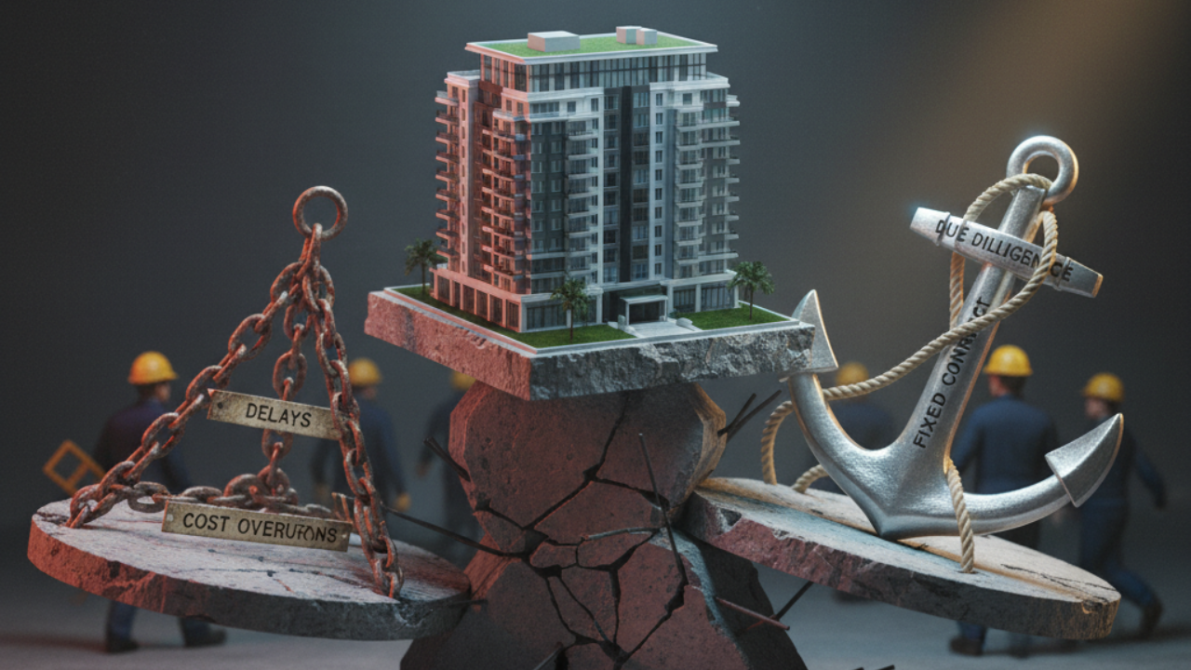
How to Prevent Builder Issues from Destroying Your Property Investment
Key Takeaways:
- Front-load due diligence with 3-4 written quotes from licensed, insured builders to avoid costly surprises
- Lock down scope with fixed-price contracts including liquidated damages clauses for delays
- Manage like a pro on-site with clear schedules, communication expectations, and proper sequencing
- Document everything-photos, variations, invoices-to protect your investment and enforce warranties
Every property investor has heard the horror stories. The builder who disappears midway through a renovation. The tradie who promises a two-week bathroom job that stretches into two months. The budget that explodes from $50,000 to $80,000 with endless “extras” and variations.
These aren’t just inconveniences-they’re investment killers that can destroy your equity, cash flow, and confidence in one fell swoop.
The brutal truth is that builder issues aren’t just common in Australian property investment; they’re almost inevitable if you don’t have the right systems in place. One delayed project can cost you thousands in lost rent, while poor workmanship can slash your property’s value and create ongoing maintenance nightmares.
But here’s what separates successful property investors from those who get burned: they treat construction management like the critical business skill it is, not an afterthought.
The Hidden Cost of Construction Chaos
When builders and tradies derail your investment, the damage goes far beyond the obvious delays and budget blowouts. Lost rental income compounds daily, opportunity costs multiply, and your reputation with lenders can suffer if projects consistently run over time and budget.
Consider this scenario: a $40,000 kitchen renovation that should take four weeks stretches to three months due to poor coordination and unreliable tradies. You’re looking at:
- Lost rent (potentially $2,000+ per month)
- Additional accommodation costs if you’re living elsewhere
- Stress of managing an out-of-control project
- Potential financing complications if timelines are exceeded
I learned this lesson the hard way during my very first bathroom renovation. I’d hired a builder-let’s call him Kevin-who came with a casual recommendation and a lot of “don’t worry about it” charm. Because he seemed like a “good bloke,” I skipped the formal vetting and handed over a deposit based on a handshake and a smile. Three days in, Kevin had gutted the bathroom, leaving me with a pile of rubble and exposed pipes… and then he vanished. No calls, no texts, nothing. For three weeks, I lived out of a suitcase at a friend’s place, chasing a ghost while my holding costs ticked away. Because I hadn’t insisted on a written scope or checked his insurance, I had zero leverage. It was an expensive, humiliating wake-up call that changed how I approach every project since. Now, the documentation and vetting strategies I’m sharing aren’t just “good advice” to me-they are my non-negotiables for survival.
The real kicker? Many investors accept this chaos as “just part of the game,” when it’s completely preventable with proper systems.
According to insights from www.propertychat.ai, which draws on over 20 years of property investment and renovation experience, a good process saves thousands by front-loading diligence, locking down scope, and managing like a professional on-site.
The Foundation: Strategic Builder Selection
The most critical decision you’ll make isn’t which tiles to choose or how much to spend-it’s selecting the right team for your project. This starts before you even request quotes.
The Three-Quote Strategy
Always obtain three to four written quotes using identical scopes of work. This isn’t just about finding the cheapest option; it’s about identifying who takes your project seriously enough to provide detailed, professional documentation.
Here’s the key principle: if a builder can’t deliver a professional quote on time, they won’t deliver your project on time either. Flaky communication during the quoting phase is a red flag that becomes an expensive reality on-site.
Vetting Beyond the Quote
Check licenses through your state’s regulatory body, verify current insurance coverage, and most importantly, call references personally. Don’t just ask if they were happy-ask specific questions about:
- Timeline adherence
- Communication quality
- Site cleanliness
- How variations were handled
- Whether final costs matched initial quotes
The sweet spot for finding reliable tradies isn’t the expensive “retail” operators or the obviously dodgy cheap options. Look for pride-in-craft tradies who work regularly for reputable builders. They’re often found through recommendations from trades you already trust or by chatting with staff at quality trade supply stores.
Contract Structure That Protects Your Investment
A solid contract is your first line of defence against project disasters. But most investors get this wrong by focusing too much on price and too little on terms.
Fixed-Price Contracts with Teeth
For newer investors especially, fixed-price contracts provide crucial certainty. But the real protection comes in the details:
- Clearly spelled out inclusions and exclusions
- Defined start and finish dates
- Structured payment schedules tied to completion milestones
- Detailed specifications for materials and finishes
The game-changer is including liquidated damages clauses. If your builder runs late without a valid variation, they’re financially responsible for your lost rent. This isn’t being harsh-it’s being professional. Most lenders prefer work contained within fixed-price building contracts anyway, so push as much legitimate work as possible into this structure to keep financing clean.
Variation Management
Variations are where budgets explode, so build strong fences around them upfront. Require all variations to be approved in writing with detailed cost breakdowns before work begins. No exceptions.
Implement a formal variation process that includes:
- Written documentation of the change
- Clear cost implications
- Timeline impact
- Your formal approval before work commences
This isn’t about being difficult-it’s about maintaining control. Verbal approvals for “quick fixes” are how $500 jobs become $2,000 surprises.
Project Management Excellence
Once contracts are signed, your role shifts from buyer to project manager. This is where many investors fail because they assume builders will manage themselves.
Site Management Systems
Act like the builder by providing each trade with a simple schedule showing who comes before and after them. Make it crystal clear they must flag delays early. Set communication expectations upfront-when they’ll call, how often, what constitutes an emergency.
Pay invoices promptly when they arrive correctly. This keeps phones answered and your jobs prioritised. Reliable payment is rare enough in construction that it becomes a competitive advantage in securing good tradies’ attention.
Material Supply Strategy
Consider supplying materials yourself to avoid the 10-15% margin many trades add, while maintaining control over quality and timing. But this only works if you’re organised and can guarantee everything is on-site when needed. Poor coordination here creates costly delays.
Successful self-supply requires:
- Accurate quantity calculations
- Storage considerations
- Delivery timing coordination
- Quality control measures
- Clear accountability for any defects
Sequence Management
This is where budgets blow out most dramatically. Every renovation has a logical sequence, and out-of-order tasks create expensive rework.
For bathrooms: services rough-in, waterproofing, tiling, then fit-off. For kitchens: demolition, rough-ins, plastering, installation, splashbacks, then fit-off. Stick religiously to these sequences to avoid costly corrections.
When to Bring in Professional Help
For major renovations or time-poor investors, professional project managers can be worth their 10-20% fee if they maintain tight programs and coordinate trades effectively. Interview them early and focus on their systems for communication, scheduling, and quality control.
However, you can often save this cost if your trades know each other and you run proper schedules. The key is honest assessment of your own time and project management skills.
When considering professional help, evaluate:
- Project complexity and scale
- Your available time commitment
- Your experience level with similar projects
- The potential cost of mistakes vs. management fees
- Whether you have reliable trade contacts already
Documentation: Your Financial Insurance Policy
Document everything from day one. Take photos before, during, and after each phase of work. Maintain a simple scope of works document, log all variations, and keep organised records of all invoices.
A comprehensive documentation system should include:
- Date-stamped photos of all stages of work
- Records of all communications with builders and tradies
- Copies of permits and approvals
- Detailed variation records
- Payment receipts and invoices
- Warranty information for all materials and appliances
This paper trail becomes crucial if something goes wrong. It lets you enforce contracts, make warranty claims, or defend against inflated charges. More importantly, it demonstrates professionalism that good tradies respect and respond to.
Red Flags That Save Thousands
Learn to recognise warning signs before they become expensive problems:
- Quotes that are significantly higher or lower than others without clear explanation
- Builders who can’t provide current insurance certificates or license details
- Projects starting without signed contracts or approved plans
- Requests for large upfront payments
- Communication that becomes sporadic after work begins
- Materials arriving on-site without your knowledge or approval
- Tradies who constantly complain about other trades’ work
- Reluctance to provide detailed timelines or schedules
Trust your instincts. If something feels wrong early in the process, it probably is.
Building Long-Term Relationships
The most successful property investors develop relationships with reliable builders and key tradies over multiple projects. This isn’t just about familiarity-it’s about mutual trust that leads to priority booking, competitive pricing, and reliable delivery.
Recognise good work publicly, pay fairly and promptly, and be firm but reasonable on scope and timelines. This professional approach attracts quality people and repels the problematic ones.
The Technology Edge
Modern project management doesn’t require expensive software, but basic tools can provide significant advantages. Simple scheduling apps, photo documentation on your phone, and shared communication platforms keep everyone aligned and accountable.
Useful technology tools include:
- Cloud-based project management apps for scheduling
- Photo documentation apps with timestamp and location data
- Digital contract and variation management systems
- Communication platforms that record all discussions
- Budget tracking software
The goal isn’t complexity-it’s clarity and consistency in communication and expectations.
Preventing builder and tradie issues from derailing your property investment isn’t about luck or hoping you find “the right people.” It’s about implementing professional systems that protect your investment while enabling quality work.
Front-load your due diligence, structure contracts that align interests, manage projects professionally, and document everything. These aren’t optional extras for serious property investors-they’re essential business practices.
Remember, as the experts at www.propertychat.ai emphasise, the biggest risk isn’t construction challenges themselves, but going in blind without proper systems and processes.
Your property investment success depends on treating construction management as the critical skill it is. Master these fundamentals, and you’ll not only avoid costly disasters but build a reliable network of professionals who help grow your portfolio profitably over time.
Want to take your property investing to the next level? Visit PropertyChat.ai for personalised guidance from Australia’s leading property investment experts.
Related Articles:
Location Masterclass: Finding the Right Property
10 Investment Strategies to Build a Property Portfolio in Australia
Refinance Your Way to Renovation
The Ultimate Guide to Renovation Framework
This article is provided in line with the Brand Voice of PropertyChat and Your Property Success, emphasising trust, actionable advice, and long-term partnership in property finance.
Transcript
Builder Nightmares That Destroy Property Investments
0:00All right, let’s get right into it. If
0:02you’re a property investor, you know
0:03that a renovation or a build, well,
0:06that’s where the magic happens. But it’s
0:08also where the nightmares can start. I
0:10mean, things can go so wrong, so fast,
0:13costing you a fortune, and just
0:15completely wrecking your whole
0:16investment plan. So, today, we’re going
0:18to break down exactly how you can stop
0:20that from ever happening to you. You’ve
0:22heard them, right? The renovation horror
0:24stories. Of course, you have. We all
0:26have. They’re basically the stuff of
0:28legend for property investors and not in
0:30a good way. It’s a huge fear and for
0:33good reason. But here’s the thing, and
0:35this is the good news. You can pretty
0:37much avoid all of it. And look, these
0:39aren’t just campfire stories. This is
0:41what actually happens to investors who
0:43just kind of wing it. You know, the one
0:45the builder who totally disappears right
0:47after he’s ripped her bathroom to shreds
0:49or the budget that just keeps exploding
0:51with all these little extras and that
0:53twoe job. Yeah. Suddenly, it’s 2 months.
0:55It can feel like a personal attack, but
0:57at the end of the day, it’s a business
0:59problem with a business solution. And
1:01this is what you really need to get. A
1:04project that runs late or, you know,
1:05just shoddy work. It’s not just a
1:07headache. It’s an investment killer. It
1:10literally eats away at your equity. It
1:12sinks your cash flow. And honestly, it
1:14can completely crush your confidence and
1:16make you question why you ever got into
1:18this. So, let’s call this what it is,
1:20the construction chaos trap. And the
1:23real cost, the hidden cost, it goes so
1:25much deeper than just the money you’re
1:27overspending. Think about it. Every day
1:29of delay is a day of lost rent. That
1:31adds up fast. Then there’s the
1:33opportunity cost. What else could you
1:34have been doing with that time and
1:36money? It can even hurt your standing
1:37with banks. It’s this downward spiral
1:39that is so so hard to pull out of once
1:41you’re in it. You know, to really bring
1:43this home, the source material for this
1:45explainer has this perfect and kind of
1:48painful personal story. the author’s
1:50first ever rena. He hired a builder
1:52named Kevin. Kevin seemed like a good
1:54guy. Came with a casual recommendation
1:56from a friend and the whole deal was
1:58sealed with a handshake. You can
2:00probably see where this is going, right?
2:01No proper checks, no real contract, just
2:04vibes. And yep, here’s the punchline. 3
2:07days into the job, the bathroom is
2:09completely gutted and poof, Kevin
2:11vanishes. Just gone. Not answering
2:13calls, not returning texts. And the
2:15author had absolutely no power, no
2:18leverage at all. Why? Because there was
2:20no written agreement, no proof of
2:21insurance, nothing. Just a pile of
2:23rubble where a bathroom used to be and
2:25holding costs that were ticking up every
2:27single day. That story just perfectly
2:30sums up the lesson, doesn’t it? That
2:32disaster was the wakeup call and it
2:34proves that having proper systems in
2:36place, well, that’s not just good advice
2:39or something you do if you have time. If
2:41you are serious about investing in
2:42property, these systems are
2:44non-negotiable. They are your survival
2:46kit. Okay, so how do we make sure that
2:50never ever happens to you? Well, it all
2:53starts way before anyone even thinks
2:56about picking up a hammer. Choosing your
2:58A team, your builder, and your trades.
3:01That is hands down the most important
3:04decision you’re going to make. And a
3:06great way to start is with what I call
3:07the three quote strategy. But listen,
3:10the real power here isn’t just about
3:12comparing prices. getting three or four
3:14detailed quotes for the exact same scope
3:16of work. That’s your first test. Think
3:19about it. If a builder can’t even get
3:20you a professional quote on time, what
3:23makes you think they’ll be any different
3:24when they’re running your actual
3:25project? It’s a massive red flag. And
3:28you can’t stop there. Your homework has
3:31to go deeper. Of course, you’ve got to
3:32check their license and their insurance.
3:34That’s basic. But the real gold is in
3:36calling their references yourself. And
3:38please don’t just ask, “So, were you
3:40happy?” Ask the tough questions. How did
3:43they handle unexpected changes? Was
3:45there a process for variations? And the
3:47big one, did the final bill actually
3:49match the quote? That’s how you uncover
3:52the real story. All right, so you’ve
3:54picked your builder. Now it’s time to
3:55build your fortress. And that fortress
3:57is your contract. Seriously, don’t think
3:59of it as just a piece of paper or some
4:00formality. It is your shield. It’s the
4:03rule book for the entire project that
4:05protects you and keeps you in control. I
4:07mean, just look at the difference here.
4:09On one side, you’ve got the classic
4:11handshake deal. It’s vague, it’s risky,
4:13and it’s basically an open invitation
4:15for your budget to explode. On the other
4:17side, a solid, professional, fixedpric
4:20contract. Everything is spelled out, the
4:22scope, the deadlines, and payment
4:24stages. One is basically rolling the
4:26dice with your money. The other is a
4:28smart business strategy. Okay. Now, this
4:31next part, this is a total gamecher.
4:34It’s a clause called liquidated damages.
4:37It sounds fancy, but what it means is
4:39simple. If the builder is late and it’s
4:41their fault, they have to pay you for
4:43your losses, like the rent you couldn’t
4:44collect. This isn’t about being mean.
4:46It’s about being professional. It makes
4:48sure everyone is motivated to finish on
4:51time. Let me tell you, variations, those
4:53little, “Oh, can we just change this
4:54moment?” That is where budgets go to
4:56die. So, you need one simple,
4:58unbreakable rule. Absolutely no verbal
5:01agreements on changes. Every single
5:03change, I don’t care how small it seems,
5:06has to be put in writing with the cost
5:08and the time delay spelled out, and you
5:10have to sign off on it before they do
5:12the work. No exceptions. That’s how you
5:14stay in the driver’s seat. Okay, so the
5:16contract signed, the tools are out, and
5:18work’s about to begin. Right now, your
5:21role completely changes. You need to
5:23take off your client hat and put on your
5:25project manager hat. From this moment
5:27on, your active, hands-on management is
5:29what’s going to make or break this
5:31project. And a huge part of that is just
5:33understanding the basic logic of how
5:35things get built. There’s an order to
5:37everything, right? You can’t put the
5:39tiles on before the waterproofing is
5:40done. You can’t install the taps before
5:42the walls are in. When you do things out
5:44of order, you have to rip them out and
5:45do them again. That costs a fortune.
5:47Just making sure things happen in the
5:49right sequence is one of the easiest
5:50ways to save money. This quote right
5:52here says it all. You have to document
5:55everything. Take photos constantly
5:57before, during, and after. Save every
6:00single email. File every invoice. Think
6:03of this paper trail as your financial
6:05insurance policy. If something goes
6:07wrong, this is your proof. It’s what
6:09lets you hold people accountable and
6:11enforce your contract. So, let’s wrap
6:13all of this up into a simple system that
6:15you can just rinse and repeat for every
6:18single project you do. The whole point
6:20is to spot trouble before it gets big.
6:22Keep control of your money and your
6:24timeline. And over time, build up a
6:26go-to team of reliable people you can
6:28trust for your next deal. And here are
6:31the red flags that will save you
6:33thousands. Think of this as your early
6:36warning system. A quote that’s way too
6:38high or way too low, red flag. A builder
6:41who can’t show you their insurance
6:42details, huge red flag. Asking for a
6:46massive upfront payment, nope.
6:48communication suddenly dropping off.
6:50That’s a classic. You have to learn to
6:52spot these signs and trust your gut. If
6:55something feels wrong, it probably is.
6:57And really, this is the main thing I
6:59want you to walk away with. As the
7:01source for this, property chat.ai points
7:03out, the biggest risk isn’t that you’ll
7:05have problems during construction,
7:07because let’s be honest, you always
7:08will. The real risk is going into it
7:11blind without the right systems to
7:13handle those problems when they pop up.
7:15So, after hearing all this, the question
7:17for you is pretty simple. Are you ready
7:20to stop taking chances and start
7:22treating your property investments like
7:23a real professional business? If that’s
7:26a yes, then your next move should be to
7:28head over to property chat.ai. You can
7:31get personalized guidance from some of
7:32Australia’s top property investment
7:34experts who’ve seen it all. They can
7:36help you build your portfolio the right
7:38way, profitably, and just as
7:40importantly, safely. Thanks so much for
7:42tuning in.
Frequently Asked Questions
How do I know if a builder’s quote is realistic or too good to be true?
Compare multiple detailed quotes for identical scopes. Quotes significantly above or below the average need clear explanation. Be particularly wary of quotes missing key components like permits, cleanup, or material allowances-these often indicate either inexperience or deliberate underquoting to win jobs. Always check if contingency amounts are included and whether GST is clearly accounted for in all calculations.
What’s the minimum deposit I should pay upfront to a builder?
Never pay more than 10% upfront or the amount needed to purchase materials for the first phase of work. Legitimate builders understand this protects both parties. Large upfront demands often indicate cash flow problems that could jeopardise your project. Structure payments to be tied to completion milestones rather than calendar dates to maintain leverage throughout the project.
Should I use the same builder for multiple properties or spread the risk?
Once you find a reliable builder who delivers quality work on time and budget, building a relationship provides significant advantages: priority scheduling, competitive pricing, and streamlined processes. However, maintaining backup options and continuing vetting their work-complacency can be costly. Even with trusted builders, always maintain proper documentation and contract procedures for every project.
How do I handle it when costs start escalating beyond the original contract?
Every legitimate cost increase must be documented in writing before work begins, including detailed breakdown and timeline impact. Review each variation against your original scope-many are attempts to charge for work that should have been included. Don’t approve variations under pressure; good builders understand that professional decisions take time. Always refer back to your original specifications and contract when evaluating whether a cost increase is justified.