
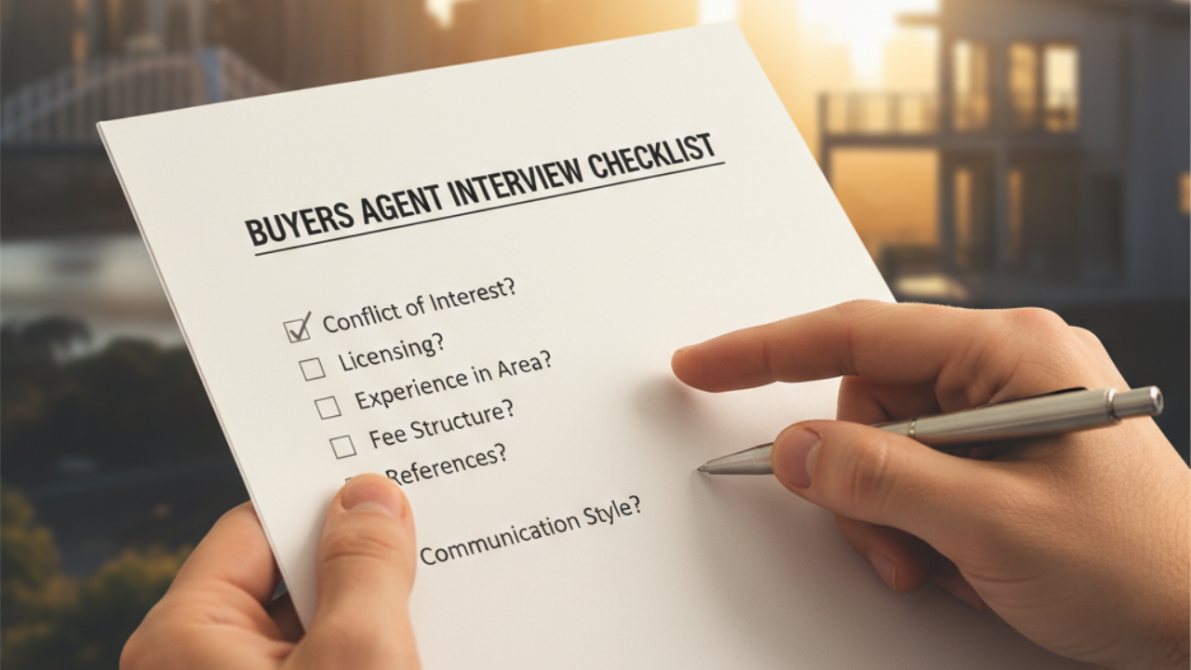
Essential Questions to Ask Before Hiring a Buyers Agent: Your Complete Guide
Key Takeaways
- Interview multiple agents: Don’t settle for the first agent you meet – compare at least three candidates when hiring a buyers agent
- Verify licensing and insurance: Ensure they’re fully licensed with Professional Indemnity insurance
- Check for conflicts of interest: Confirm they don’t take vendor commissions or work with developers
- Assess their expertise: Look for specialists in your target market and price range
- Understand their fee structure: Opt for fixed fees rather than percentage-based commission
- Evaluate their network: Strong industry connections provide access to off-market opportunities
Every property investor faces a critical decision that could make or break their financial future. You’re about to commit tens or hundreds of thousands of dollars to a property purchase, yet most people spend more time researching their next smartphone than vetting the buyer’s agent who’ll guide this monumental investment.
The Australian property market is unforgiving. One wrong move, buying in the wrong suburb, paying above market value, or missing crucial due diligence, can cost you years of wealth building and financial security. Yet countless investors rush into agent relationships without asking the fundamental questions that separate the professionals from the pretenders.
The consequences of choosing poorly are severe. You might end up with an agent who prioritises their commission over your interests, lacks knowledge of your target areas, or worse, steers you toward properties that benefit them rather than you. Some agents double-dip by taking commissions from both buyers and vendors, creating conflicts that compromise your negotiating position.
Let me take you behind the curtain for a moment. Years ago, when I set out to buy my very first investment property, I nearly made the mistake this article warns about. I met with a buyers agent who seemed to tick every box on paper, he was polished, quick with market stats, and assured me he “knew everyone worth knowing” in the neighbourhood. Frankly, I wanted to believe him. But that night, something nagged at me. So, I wrote down the toughest questions I could think of about conflicts of interest, insurance, and past client outcomes. When I presented those the next day, I watched his confidence waver. Suddenly, his “extensive network” came down to a few vague names, and his track record became a foggy set of stories I couldn’t verify. I politely walked away, and thank goodness I did. If I’d settled for the first agent who impressed me, I would’ve missed the off-market gem I eventually purchased with the help of a truly independent, expert agent. This experience cemented my conviction: asking hard questions doesn’t make you difficult, it makes you a smart investor. Protect your money and your future by pressing for clarity, even when it feels uncomfortable. You and your portfolio will thank you.
But here’s what 20 years of property investment expertise has taught us: asking the right questions upfront transforms your entire buying experience. When you know what to ask, you can identify genuine professionals who work exclusively in your interests, possess deep market knowledge, and have the proven track record to secure properties below market value when hiring a buyers agent.
According to PropertyChat.ai, which draws from two decades of property investment wisdom, there’s a specific set of questions that separate exceptional buyers agents from the rest of the field.
What Makes a Great Buyers Agent?
Before diving into specific questions, it’s crucial to understand what you’re looking for in a buyers agent. The best agents operate as independent property investment consultants who work exclusively for buyers, not vendors or developers.
They bring several key advantages to your property search:
- Exclusive buyer representation with no conflicting interests
- Access to off-market properties through extensive industry networks
- Professional property evaluation based on investment fundamentals
- Skilled negotiation to secure properties below asking price
- Market expertise in specific suburbs and property types
- Due diligence support throughout the purchasing process
The Australian property landscape has evolved significantly, with buyers agents becoming increasingly important as markets become more competitive and information asymmetries persist between buyers and sellers.
The Essential Questions Every Property Investor Must Ask
1. Do You Also Sell Property?
This is perhaps the most critical question you can ask. A buyers agent who also lists properties for vendors creates an inherent conflict of interest that can compromise your position.
Why this matters: Agents who work both sides of the market may be tempted to steer you toward their own listings or those of their colleagues, rather than securing the absolute best deal for you. They might also have relationships with developers who offer kickbacks for buyer referrals.
What to look for: Seek agents who work purely for buyers, taking no commissions from vendors or developers. This ensures their only incentive is securing discounts and off-market properties for their clients.
2. What’s Your Point of Difference?
Every professional should be able to articulate what sets them apart from competitors. This question reveals whether you’re dealing with a specialist or just another generalist trying to win your business.
Listen for these differentiators:
- Independence from vendor relationships
- Full-time dedicated research analysts
- Proven track record with verified results
- Industry awards and recognition
- Specialised market knowledge
- Extensive professional networks
Red flags: Vague responses, inability to provide specific examples, or claims they can’t substantiate with evidence.
3. Are You Fully Licensed as a Buyers Agent?
Professional licensing isn’t optional, it’s mandatory. But you need to dig deeper than just confirming they hold a license.
Essential requirements:
- Current buyers agent license (not just a general real estate license)
- Professional Indemnity insurance with named insurer
- Policy reference numbers you can verify
- Membership in relevant professional bodies
Why Professional Indemnity matters: This insurance protects you if the agent makes errors that cost you money. Any professional buyers agent should carry substantial PI coverage and be willing to provide policy details.
4. Do You Have a Strong Network of Real Estate Contacts?
The best opportunities in property investment often never reach public marketing. Agents with strong industry networks can access these “silent sales” that give you competitive advantages.
What strong networks provide:
- Early access to off-market listings
- Relationships with selling agents for better negotiation
- Connections with quality service providers (conveyancers, finance, inspectors)
- Market intelligence unavailable to the general public
How to assess their network: Ask for specific examples of off-market deals they’ve secured for clients. Quality agents should be able to provide recent case studies without revealing confidential client information.
5. What Experience Do You Have in Property Research and Negotiation?
Property evaluation and negotiation are core competencies that separate professionals from amateurs. Your agent should have systematic approaches to both.
Research capabilities should include:
- Comparative market analysis methodologies
- Due diligence processes for property evaluation
- Understanding of local planning and development
- Access to professional research tools and databases
Negotiation experience indicators:
- Average discount achieved below asking prices
- Success rate in competitive situations
- Strategies for different market conditions
- Examples of creative deal structures
6. What Types of Properties and Areas Do You Specialise In?
Specialisation indicates expertise. An agent who tries to cover every property type and location likely lacks deep knowledge in any particular area.
Look for agents who:
- Focus on specific geographic regions they know intimately
- Specialise in particular property types (houses, units, new vs established)
- Understand local market cycles and drivers
- Can articulate why certain areas offer better investment potential
Market knowledge indicators:
- Recent sales data and trend analysis
- Understanding of local infrastructure developments
- Awareness of planning changes affecting values
- Insights into rental market dynamics
7. What Success Have You Achieved for Clients in the Last 12 Months?
Past performance doesn’t guarantee future results, but it provides valuable insights into an agent’s capabilities and track record.
Specific metrics to request:
- Number of successful purchases completed
- Average time from engagement to settlement
- Percentage of offers that proceed to purchase
- Average discount achieved below asking prices
- Client testimonials and references you can contact
Warning signs: Reluctance to provide specific data, inability to offer client references, or claims that seem too good to be true without supporting evidence.
8. Are You a Member of Professional Industry Bodies?
Professional memberships demonstrate commitment to industry standards and ongoing education.
Key memberships to look for:
- Real Estate Institute of Australia (state-specific)
- Buyers’ Agents Association
- Property Investment Professionals of Australia
- Local real estate industry groups
What memberships indicate:
- Commitment to professional development
- Adherence to industry codes of ethics
- Access to ongoing education and training
- Networking with other industry professionals
9. How Do You Structure Your Fees?
Fee structure reveals a lot about how an agent operates and whether their interests align with yours.
Preferred fee structure: Fixed fees based on your budget range, typically 1-2% of purchase price or $10,000-$20,000 nationally. This removes any incentive for the agent to inflate purchase prices to increase their commission.
Fee structures to be cautious about:
- Percentage-based fees that increase with property price
- Success fees that might encourage rushed decisions
- Retainer structures without clear deliverables
- Hidden costs or additional charges
10. Do You Handle Complex Situations?
Property investment often involves unique circumstances that test an agent’s expertise and problem-solving abilities.
Complex scenarios might include:
- Expatriate buyers with offshore finance
- Self-managed superannuation fund purchases
- Development site acquisitions
- Distressed or motivated vendor situations
- Properties requiring significant renovation
Why this matters: An agent’s ability to navigate complex situations indicates their depth of experience and professional network. It also suggests they can add value beyond basic property identification.
Red Flags to Watch For
While asking the right questions is crucial, recognising warning signs is equally important:
Immediate Red Flags
- Reluctance to answer direct questions about credentials
- Inability to provide client references or testimonials
- Claims about guaranteed returns or risk-free investments
- Pressure to sign agreements without time for consideration
- Vague or evasive responses about their experience
Subtle Warning Signs
- Limited knowledge of current market conditions
- Generic rather than specific examples of their work
- Poor communication skills or responsiveness
- Lack of systematic processes for property evaluation
- No clear value proposition beyond “finding properties”
Making Your Final Decision
After interviewing multiple candidates and asking these essential questions, you should have a clear picture of each agent’s capabilities and approach.
Decision criteria should include:
- Professional credentials and licensing
- Relevant experience in your target market
- Communication style and availability
- Fee structure alignment with your interests
- Strength of professional network
- Cultural fit and personal rapport
The interview process typically involves:
- Initial phone screening (15-30 minutes)
- Detailed face-to-face or video interview (45-60 minutes)
- Reference checks with previous clients
- Review of sample reports or case studies
- Clarification of terms and fee structures
Remember, this decision will significantly impact your property investment success. Take time to thoroughly evaluate each candidate against these criteria.
Working With PropertyChat.ai for Additional Insights
For property investors seeking additional guidance on buyers agent selection and property investment strategy, PropertyChat.ai provides access to 20 years of proven investment expertise. This AI-powered platform, built on Jane Slack-Smith’s extensive property knowledge, offers personalised guidance on everything from agent selection to market analysis.
PropertyChat.ai can help you:
- Refine your buyers agent selection criteria
- Understand local market dynamics
- Develop investment strategies aligned with your goals
- Access comprehensive property investment education
The platform complements professional advice from qualified buyers agents, mortgage brokers, and other property professionals while providing on-demand access to proven investment frameworks.
Choosing the right buyers agent is one of the most important decisions you’ll make in your property investment journey. The questions outlined in this guide, developed from 20 years of property investment expertise and proven strategies, will help you identify professionals who truly work in your interests.
Remember that great buyers agents offer more than just property identification. They provide access to off-market opportunities, skilled negotiation, market expertise, and professional networks that can significantly improve your investment outcomes.
Take time to interview multiple candidates, ask the tough questions, and don’t rush your decision. The right buyers agent will become a valuable long-term partner in building your property investment portfolio.
The property market rewards investors who do their due diligence, and that starts with choosing the right professional team to support your goals.
Related Resources:
How to Avoid Buying the Wrong Property and Losing Money: Essential Australian Investment Guide
Buyers Agent vs Real Estate Agent: Key Differences Explained
What Does It Cost to Hire a Buyers Agent in Australia? The Complete 2025 Guide
10 Mistakes Property Buyers Make and How to Avoid Them
This article is provided in line with the Brand Voice of PropertyChat and Your Property Success, emphasising trust, actionable advice, and long-term partnership in property finance.
Transcript
5 Hidden Questions Your Buyers Agent Hopes You Never Ask
0:00Welcome to the explainer. Today we’re
0:02diving into a decision that can
0:04literally make or break your entire
0:06property journey. How to choose the
0:08right buyer’s agent. We’re going to arm
0:10you with the exact questions you need to
0:11ask to get this right. So, let’s start
0:14with this idea because it’s wild when
0:16you think about it. Most of us will
0:17spend hours, maybe even days researching
0:20a new phone, but for the person guiding
0:22the biggest purchase of our lives, not
0:24so much. That’s a huge, huge risk. So,
0:27let’s fix that. You know, the Australian
0:29property market can be an absolute
0:31minefield. Having a good guide is
0:33critical, but choosing the wrong one,
0:35woof, that’s not just a little oopsie.
0:38It could mean overpaying by tens of
0:39thousands or worse, buying the wrong
0:41asset altogether. The stakes couldn’t be
0:44higher. And here’s the real risk. You
0:47could end up with someone who isn’t
0:49actually on your team. You know, someone
0:51who’s more focused on their commission
0:52check than your financial future, or
0:55someone who just doesn’t have that deep
0:56local knowledge you need. That’s the
0:58core problem we’re going to solve today.
1:01All right, let’s get right into the
1:02questions. This first set is, I think,
1:05the most important. It’s all about
1:07allegiance. We need to figure out who
1:09they really work for. Okay, this is it.
1:12This is the big one. If you only ask one
1:14question, make it this one. The answer
1:16tells you almost everything you need to
1:18know about their business model and
1:20where their loyalties might be split.
1:22And here’s why that question is so
1:24powerful. An exclusive buyer’s agent has
1:26one job and one job only to get you the
1:29best property at the best price. Simple.
1:31But an agent who also sells property.
1:33Well, they’ve got a massive potential
1:35conflict of interest. Are they showing
1:36you the best house on the market or are
1:38they pushing you towards one of their
1:39own listings to double their commission?
1:41You need to know their allegiance is
1:43100% with you. Next up, let’s talk about
1:46licenses and insurance. Now, I know this
1:48sounds a bit like boring paperwork, but
1:50trust me, there’s a critical detail here
1:51that you absolutely cannot overlook.
1:54This is all about protecting you. That
1:57professional indemnity insurance or PI
1:59insurance is a total non-negotiable.
2:02Think of it as your financial safety
2:03net. If the agent makes a huge mistake
2:05that costs you a fortune, this is what
2:07protects you. And don’t just take their
2:09word for it. Ask to see the policy. A
2:11real pro will have no problem showing
2:13you. Okay, so you’ve confirmed they’re
2:15loyal and they’re legit. Now for the fun
2:17part. Let’s see if they’re actually any
2:19good at their job. Can they deliver the
2:21goods? I love this question. It really
2:24separates the true specialists from the
2:27generalists. Any agent worth their salt
2:29should be able to tell you clearly and
2:31confidently what makes them different
2:33from the hundreds of other agents out
2:35there. And listen carefully to their
2:37answer. You don’t want to hear vague
2:39stuff like, “Oh, we provide great
2:40service.” You want specifics. Do they
2:43have a dedicated research team? What’s
2:45their network like for finding
2:46off-market properties? Can they show you
2:48actual verifiable results? That’s the
2:51proof in the pudding. This one is a real
2:54BS detector. It cuts through all the
2:56marketing fluff and gets straight to the
2:58point. Forget what they say they can do.
3:00What have they actually done for people
3:02like you recently? And here’s a little
3:04pro tip, a real power move. Don’t just
3:07ask if they get their clients a good
3:09deal. ask for their average discount
3:11achieved below the asking price. That’s
3:14a hard number, a key performance
3:16indicator. It tells you exactly how good
3:18they are at negotiating. You’ve got to
3:20be skeptical of anyone who claims
3:22they’re an expert everywhere. Real
3:24estate is so local. An agent who lives
3:26and breathes a handful of suburbs is
3:28infinitely more valuable than a jack of
3:30all trades. You’re paying for
3:31specialized expertise, so make sure
3:33that’s what you’re getting. All right,
3:35we’re on the home stretch. Let’s get
3:37into the nitty-gritty. the process. We
3:39need to understand how they work and
3:40crucially how they get paid. This tells
3:43you so much about what motivates them.
3:45The fee structure is like a window into
3:47an agent’s soul. Okay, maybe that’s a
3:50bit dramatic, but seriously, how they
3:51charge you tells you if their financial
3:53incentives are actually aligned with
3:55yours. And the difference here is night
3:57and day. Think about it. If they charge
4:00a percentage of the purchase price, they
4:02literally make more money if you pay
4:03more for a house. That is a massive
4:05conflict of interest. But a fixed fee
4:08that aligns everyone. Their job is to
4:10find you the best property, period. Not
4:13the most expensive one. So asking all
4:16these questions is fantastic, but it’s
4:18only half the battle. The other half is
4:20listening to the answers and knowing
4:22when you hear something that should make
4:23you turn around and walk away. These are
4:26what I call the deal breakers, the giant
4:29flashing neon red flags. If they get
4:32dodgy with their answers, if they can’t
4:33give you references, if they promise
4:35guaranteed returns, or if they pressure
4:37you to sign right away, just no. A real
4:40professional has nothing to hide. And
4:42then you’ve got the more subtle warning
4:44signs. These might not be dealreakers on
4:47their own, but they are definitely
4:48things that should make you pause.
4:50Things like vague answers, being slow to
4:52get back to you, or not having a clear,
4:54systematic process. These often point to
4:56a lack of real depth and experience. So
4:59once you’ve put at least three different
5:02agents through this ringer, once you’ve
5:04asked these tough questions and you’ve
5:05watched out for the red flags, you are
5:07going to be in such a powerful position
5:09to make a confident decision based on
5:12facts, not a sales pitch. And please
5:15remember, the real goal here isn’t just
5:17to buy one house. It’s to find a trusted
5:20adviser, a long-term partner who can
5:22help you on your entire wealthb
5:23buildinging journey. This is a
5:25relationship, not just a one-off
5:27transaction. Now, for those of you who
5:29are really serious about this, who want
5:31to take your strategy to the next level
5:33and tap into a couple of decades of
5:35proven investment wisdom, there is a
5:37fantastic tool I want to share with you.
5:39You need to go to property chat.ai.
5:42It is an incredible resource. It uses AI
5:45to give you guidance that can help you
5:47understand the market, build out your
5:49strategy, and just make smarter
5:50investment decisions every single step
5:52of the way. Go check it out.
Frequently Asked Questions
How many buyers agents should I interview?
Interview at least three buyers agents from different firms to get a comprehensive understanding of available options. This allows you to compare credentials, experience, fee structures, and communication styles before making your decision.
What’s the typical cost of hiring a buyers agent?
Buyers agents typically charge 1-2% of the purchase price or fixed fees ranging from $10,000-$20,000 nationally. Fixed fee structures are preferred as they align the agent’s interests with securing the best property rather than the most expensive one.
How long should the buyers agent selection process take?
Allow 2-4 weeks for the complete selection process, including initial research, interviews, reference checks, and final decision. Rushing this decision could cost you significantly more than taking time to choose the right professional.
Can I work with multiple buyers agents simultaneously?
Most buyers agents require exclusive arrangements during active property searches. However, you might work with different agents for different geographic areas or property types, provided this is clearly communicated and agreed upon in advance.