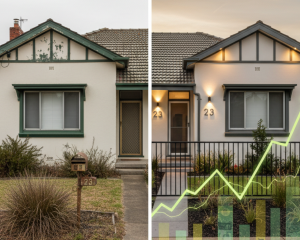
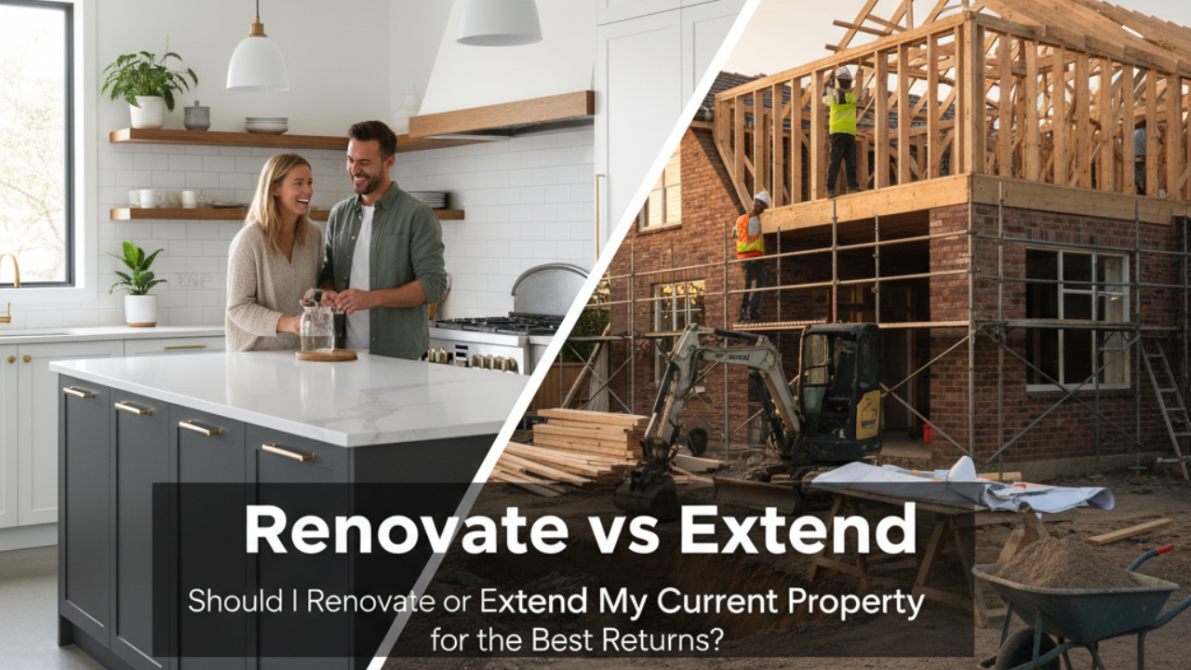
Renovate vs Extend: Should I Renovate or Extend My Current Property for the Best Returns?
Key Takeaways
- Renovation returns: Kitchen renovations deliver 55-75% ROI and bathrooms return 60-80% in the current Australian market.
- Extension benefits: Can deliver up to 100% return for additional bedrooms in family-focused areas while boosting rental yield.
- Timeline matters: Your investment horizon determines the best strategy, renovations suit a 2-3 year hold, while extensions are better suited to 7-10 year wealth building.
- Market demand drives success: Understanding your suburb’s buyer profile is more critical than personal preferences when deciding whether to renovate vs extend.
Property investors across Australia face the same dilemma: should I renovate or extend my current property for maximum returns? With construction costs stabilising at 32% above pre-pandemic levels and the Australian renovation market contributing $48 billion to the economy, this decision has never been more crucial for building wealth.
The answer isn’t straightforward. While renovation can deliver solid returns of 55-80% when executed correctly, extensions offer unique advantages for long-term wealth creation through increased rental yields and genuine value addition. According to insights from PropertyChat.ai, the decision hinges on your actual investment goals, timeline, and market positioning rather than what looks appealing on renovation shows.
I know this dilemma isn’t just theoretical, I’ve lived it. Back in 2001, I stood at exactly this crossroads. On one side was a brand-new, beautiful property at $550,000. On the other was an older, unrenovated one at $425,000 that I knew I could improve. Every instinct said go for the shiny new one. It felt safer, cleaner, less risky. But when I ran the numbers and looked honestly at my investment goals, I chose the older property and renovated it. That decision changed everything. The property is now worth over $1.2 million, and more importantly, the equity I manufactured through that renovation let me buy my second, third, and fourth properties far faster than if I’d gone the safe route. The new build would have grown incrementally. The renovated property grew strategically. That’s the difference this decision can make. It’s not about which option looks better on paper or feels more comfortable, it’s about which strategy aligns with where you want to be in five, ten, or twenty years.
Understanding the Real Difference Between Renovation and Extension
When property investors talk about adding value, they often confuse cosmetic improvement with genuine wealth creation. These are fundamentally different strategies with distinct financial outcomes.
Renovation typically involves cosmetic enhancement, kitchen refreshes, bathroom updates, fresh paint, new flooring, and landscaping improvements. You’re essentially filling the gap between what an unrenovated property sells for and what a modernised one commands in the market. The returns can be substantial, with kitchen renovations delivering 75% ROI and bathroom upgrades returning 60-80% according to 2024 Australian renovation statistics.
However, renovation returns are generally one-off gains tied to sale or refinance events. A well-executed cosmetic renovation in Melbourne might add $80,000-$150,000 to property value, but the improvement doesn’t generate ongoing income benefits for investors holding long-term.
Extension adds actual usable space, additional bedrooms, granny flats, second living areas, or extra storeys. This strategy creates longer-term wealth through multiple channels. Extensions boost rental income immediately if you’re holding as an investment property, add genuine market value through increased living space, and create flexibility for changing family needs in owner-occupied properties.
The key distinction lies in ongoing benefits. While renovation improves what exists, extension creates something new that can generate additional income and appeal to broader buyer markets when you eventually sell.
When Renovation Makes Strategic Sense
Renovation delivers optimal returns when your investment horizon is shorter and market positioning needs refinement rather than expansion. Smart renovators focus on closing value gaps rather than over-capitalising on improvements.
Target timeline: 2-3 year maximum hold period
If you’re planning to sell within the next few years, strategic cosmetic renovation often provides better bang for buck than extension work. The Australian property market consistently shows renovated properties sell 10-15% faster than unrenovated equivalents, reducing holding costs and market exposure risk.
Focus on high-impact, cost-effective improvements
Current Australian renovation data shows bathroom modernisation returning 60-80% and kitchen updates delivering 55-75% ROI. Success, however, depends on matching improvements to property and suburb expectations. A $50,000 kitchen renovation in a $600,000 property might return $35,000-$40,000 in added value, while the same spend in a $1.2 million home could return $45,000-$50,000.
Avoid the over-capitalisation trap
Recent discussions among Australian renovators highlight a concerning trend. Properties in eastern suburbs might sell for $1.7 million unrenovated versus $2 million renovated, but if renovation costs exceed $250,000, you’re destroying wealth rather than creating it. The discount for unrenovated properties versus fully renovated homes often sits at only 10-20%, making expensive renovations financially questionable. Understanding your suburb’s price ceiling before you begin is one of the most important steps you can take.
Market demand analysis is crucial
Understanding what your specific suburb actually needs matters more than personal preferences. Family-heavy areas might benefit from additional bathroom space, while professional neighbourhoods value home office flexibility. PropertyChat.ai emphasises this research-driven approach over emotional decision-making, and it’s a principle that underpins every good renovation or extension strategy.
Extension Strategy for Long-Term Wealth Building
Extensions create lasting value through multiple wealth-building mechanisms that compound over time. This approach suits investors with longer holding periods and growth-focused portfolios.
Target timeline: 7-10 year wealth building strategy
Extension investments perform best when you can capture both immediate rental yield improvements and long-term capital growth. Adding a granny flat might cost $120,000-$180,000 but could increase rental income by $200-$350 per week while adding $150,000-$250,000 in property value in suitable locations.
Dual income potential transforms returns
Second dwellings, additional bedrooms, or separate living areas create immediate rental income opportunities. A well-designed granny flat in Sydney’s growth corridors can generate $300-$400 in weekly rental income while the main dwelling continues producing its existing yield. This dual-income approach can improve total property yield from 3.5% to 5.5% or higher.
Future-proofing for demographic changes
Extension work often addresses longer-term market trends rather than immediate cosmetic appeal. Multi-generational living, work-from-home requirements, and rental affordability pressures all favour properties with flexible space options. Extensions that anticipate these needs often deliver stronger long-term performance than cosmetic improvements.
Capital growth through genuine improvement
Unlike renovation, which mainly repositions existing value, well-planned extensions create new value through additional living space. Second-storey additions can transform single-level properties into family homes suitable for different buyer segments. This transformation expands your potential buyer pool at sale time while improving holding period returns.
Financial Comparison: Renovation vs Extension ROI, Which Delivers Better Returns?
Understanding the true financial impact of each strategy requires analysis beyond simple cost-versus-value calculations. Different approaches suit different investment goals and timelines.
Renovation financial profile
Cosmetic renovations typically cost $25,000-$75,000 for bathrooms and kitchens combined. Current Australian data shows kitchen renovations averaging $27,500 and bathroom upgrades costing approximately $19,000 for mid-range projects. These improvements can add $40,000-$120,000 in property value when well-executed.
Renovation provides faster capital access through refinancing options. Improved properties often support higher loan-to-value ratios, unlocking equity for additional investment opportunities. This velocity advantage suits investors focused on portfolio expansion rather than single-property optimisation.
However, renovation improvements depreciate over time. A $50,000 kitchen renovation loses appeal after 7-10 years, requiring refresh spending to maintain value premiums. This ongoing maintenance cost reduces long-term returns compared to structural improvements.
Extension financial profile
Extensions require larger upfront investments, typically $80,000-$250,000 depending on scope and quality. However, they create lasting value through multiple channels. Additional bedrooms might add $100,000-$200,000 in capital value while improving rental yields by $100-$300 per week.
Extension improvements tend to appreciate with property markets rather than depreciate like cosmetic finishes. A well-built granny flat or additional living space retains functionality and appeal for decades with minimal maintenance spending.
Cash flow benefits compound over holding periods. An extension adding $200 in weekly rental income generates $10,400 annually, providing a 5.2% annual return on a $200,000 extension investment before considering capital growth benefits.
Break-even analysis considerations
Renovation break-even typically occurs at sale, requiring market timing and buyer demand alignment. Extension break-even happens progressively through rental income improvements, reducing market timing dependency.
Consider holding costs during construction. Renovations might reduce rental income for 1-2 months while extensions can impact cash flow for 3-6 months. Factor these opportunity costs into financial comparisons alongside direct construction expenses.
Making Your Decision: A Strategic Framework for Renovate vs Extend
Successful property improvement decisions require systematic analysis rather than intuition or external pressure. Use this framework to evaluate your specific situation objectively.
Define your investment horizon clearly
Short-term holds (2-3 years) generally favour renovation strategies focused on market positioning improvements. Medium-term holds (4-7 years) can justify moderate extension work if rental yields improve significantly. Long-term holds (7+ years) support major extension investments that create lasting value.
Assess property-specific factors
Analyse your property’s current position in the local market. Properties priced below suburb medians often benefit from renovation improvements that close value gaps. Properties already well-positioned might benefit more from extension work that creates new value rather than competing on existing attributes.
Calculate realistic financial outcomes
Model multiple scenarios with conservative assumptions about costs, timelines, and value improvements. Include opportunity costs, holding expenses, and financing charges in calculations. Consider taxation implications of each strategy and consult a qualified tax professional about optimising structures for your specific situation.
Market validation before commitment
Research recent sales of improved properties in your area to validate value improvement assumptions. Speak with local agents about buyer preferences and market trends. Test rental demand if extension work aims to improve yields, overestimating rental returns can destroy extension project feasibility quickly.
The choice between renovation and extension ultimately depends on your investment strategy, timeline, and property-specific factors rather than general rules or popular trends. Renovation suits shorter-term wealth creation through market repositioning, while extension creates lasting value through additional space and income potential.
Smart property investors base decisions on thorough market research, realistic financial analysis, and a clear understanding of their investment goals. Whether you choose to renovate or extend, success requires matching improvements to genuine market demand rather than personal preferences.
The fastest path to wealth isn’t necessarily through property improvements alone. It’s through making informed decisions that align with market realities and your specific financial goals. Take time to research properly, plan thoroughly, and execute with quality professionals who understand investment property requirements.
Ready to make a confident decision about your property improvement strategy? PropertyChat.ai offers proven frameworks and expert insights, backed by 20 years of real-world property investment success, to guide your next steps toward building lasting property wealth. Start a free conversation today at www.propertychat.ai.
Related Articles You Might Find Useful
Common Renovation Mistakes: Avoid Pitfalls as a First-Time Renovator
What ROI Can You Expect From Renovating a Rental Property?
Best Investment Property Improvements for Instant Equity
Renovation vs Buying New: Comparing Costs and Savings in 2025
This article is provided in line with the Brand Voice of PropertyChat and Your Property Success, emphasising trust, actionable advice, and long-term partnership in property finance.
Transcript
Renovate vs Extend: The Surprising Truth About Maximising Returns.
0:00So, if you’re a property investor, you know you’re going to hit this fork in the road sooner or later. And the path you choose, well, it can literally be
0:08
the difference between a pretty good return and a life-changing one. The big question is, do you renovate or do you extend? Today, we are going to break
0:15
that down and get you the clarity you need to make the right call for your portfolio. And look, I’m not just talking theory here. Back in 2001, I was standing at that exact same crossroads.
0:27
I made a call. I chose an older property and I renovated it. That single decision, that one strategic move,
0:33
unlocked the equity that let me go out and buy my next three properties. That’s the kind of power we’re talking about when you make the right choice. So, how do we make this massive decision? Well,
0:42
we’re going to break it down step by step. We’ll start at that investor’s crossroads, look at the two very different ways you can create value, and
0:49
then we’ll put renovation and extension to the test. And then the most important part, I’ll give you a simple framework you can use to make the right choice for your own property. Let’s get into it.
0:59
And make no mistake, this is a huge deal. We’re talking about a 48 billion dollar industry just here in Australia.
1:06
And with construction costs having soared 32% since the pandemic, while the financial stakes have never ever been higher, getting this right is absolutely
1:15
crucial. Okay, now here’s a trap so many investors fall into. They think that making a property look better is the exact same thing as making it more
1:23
valuable. But believe me, there is a world of difference between a simple cosmetic touch-up and a real act of genuine wealth creation. Let’s break down what that actually means. So,
1:33
what’s the real difference, right? Think of it like this. A renovation is like giving your car a brand new paint job.
1:39
It looks amazing, and yeah, it’s resale value might get a little temporary bump, but it’s still the same car underneath.
1:45
An extension on the other hand is like dropping in a brand new more powerful engine. You are creating something entirely new that adds real lasting value and performance. One is a refresh.
1:55
The other is a fundamental upgrade. Okay, let’s talk about renovation first.
2:00
This is your go-to strategy if you’re looking for a quick win. The goal here is pretty simple. You buy a property that’s looking a little bit dated. You fix it up to meet what the market wants
2:09
and then you either sell it or refinance it for a nice profit. And here’s what that timeline usually looks like. You’re in and you’re out in about 2 to 3 years.
2:17
You finish the reno. You refinance within that first year to pull out all that new equity you’ve just created. And then you’re primed to sell for a solid
2:24
profit. It’s all about speed and keeping your capital moving. Now, here’s the juicy part. Let’s talk returns. A smart
2:32
bathroom Reno can give you a massive 60 to 80% return on your investment. And kitchens, they’re not far behind. These are the high impact zones where a
2:40
strategic investment, I’m talking new benchtops, modern taps, a fresh coat of paint can make you some serious money and fast. But, and this is a huge butt,
2:51
you have to avoid the critical trap of over capitalization. It’s basically like putting a gold-plated engine in a rusty old car. You will never get that money
2:59
back. If you spend 250 grand renovating a house in a suburb where the absolute top sale price is 2 million, you’ve just
3:06
thrown your money away. You have to know your market ceiling before you spend a single dollar. So, that’s the quick win.
3:14
But what if you’re not in it for a quick flip? What if you want to build real lasting wealth that grows and compounds over time? Well, that’s where extensions come into play. This is the long game.
3:24
And you can see right away the timeline is completely different. We’re talking about holding for 7 to 10 years and often a lot longer. You build the
3:32
extension, you immediately start bringing in more money from increased rent, and then you just sit back and let your high-erforming asset grow in value
3:39
for years and years. And the numbers here, they can be absolutely staggering.
3:44
A simple granny flat can put an extra 350 bucks a week straight into your pocket. Just let that sink in for a
3:51
second. That’s over $18,000 a year in pure extra cash flow. I mean, what could you do with that kind of income boost?
3:58
But it’s not even just about the money right now. What you’re doing is futureproofing your investment. You’re creating a home that actually works for
4:05
modern families, for the huge number of people working from home, for multigenerational living. You’re not just adding value today. You’re making
4:12
your property way more desirable to a much bigger pool of buyers and renters for decades to come. All right, it is time for the showdown. Let’s put these two powerful strategies head-to-head.
4:23
We’ve gone through the theory, but now let’s see how they really stack up when we run the numbers and compare them on the metrics that actually matter to an investor. So, here it is, the breakdown.
4:32
Clear as day. Renovations cheaper upfront and you get your capital out faster. But, and here’s the kicker, the value you’re adding is cosmetic. It’s a
4:40
depreciating asset. That beautiful kitchen will look dated in 10 years. Extensions cost more and take longer,
4:46
yes, but you’re adding real structural value that actually grows with the market. And most importantly, look at that last row. You’re creating a positive, brand new stream of income.
4:56
And let’s not forget something a lot of people miss. The time your property is just sitting there empty. A cosmetic reno might mean a month or two of lost
5:04
rent, which stings. But a major extension, that could be half a year with zero income. That is a serious holding cost that you absolutely have to factor into your budget from day one.
5:15
Okay, so we’ve seen the pros, we’ve seen the cons, we get the numbers, but how do you actually decide what’s right for your specific property? It’s not about guessing or following a trend on TV.
5:25
It’s about having a clear, repeatable plan. So, here it is, a simple framework you can use to make the right call every single time. It’s a four-step process.
5:34
First, be brutally honest with yourself about your timeline. Are you in this for 2 years or 20? Second, take a hard look
5:41
at your property. Does it just need a facelift or is there a genuine opportunity to add new valuable space?
5:48
Third, crunch the numbers. And I mean all the numbers, including those holding costs we just talked about. And finally,
5:54
number four, do your homework. Talk to local agents, research recent sales, and validate all your assumptions. Don’t make a single move until you’ve done the research. Because at the end of the day,
6:04
it’s not about what’s trendy or what you see on some home improvement show. Smart investing is about your goals. It’s about making a calculated, informed
6:12
decision that is right for you, your finances, and your future. So, I’m going to leave you with this challenge. Forget about next month. Forget about next
6:20
year. Where do you want your portfolio to be in 10 years? And which one of these two very distinct paths is truly
6:28
going to get you there? The choice is yours. If you’re ready to take that next step and really build a property portfolio that can genuinely change your
6:37
life, I’m here to help. You can start a completely free, no strings attached conversation with me today at www.propychhat.ai.
6:46
Let’s make it happen.
Frequently Asked Questions
How much should I budget for a kitchen versus bathroom renovation in Australia?
Current Australian market data shows kitchen renovations averaging $27,500 while bathroom upgrades cost approximately $19,000 for mid-range projects. However, costs vary significantly by location and quality level, Sydney projects typically cost 15-20% above national averages. Always obtain multiple quotes and include a 10-15% contingency budget for unexpected issues. Getting this right is one of the most important steps in ensuring your renovation delivers a strong home renovation ROI.
What is the typical return on investment for adding a granny flat versus renovating existing spaces?
Well-executed granny flats can deliver up to 100% return in suitable family suburbs through combined capital value improvement and rental income generation, making them one of the strongest property extension benefits available to Australian investors. Renovation typically returns 60-80% for bathrooms and 55-75% for kitchens. However, granny flat success depends heavily on local council regulations, site suitability, and rental demand in your specific area.
Should I renovate before selling, or price the property as-is for a quicker sale?
This depends on your property’s current condition relative to local market standards and your available timeline. Properties requiring only cosmetic improvements often benefit from strategic renovation before sale, particularly if you can capture a 70%+ return on investment. However, if renovation costs exceed 15% of property value or you need a quick settlement, selling as-is often provides a better net outcome. Understanding the extension vs renovation cost equation for your specific property is essential before committing either way.
How long do extension projects typically take compared to renovation work?
Renovation projects usually complete within 4-8 weeks for kitchens and bathrooms combined. Extension work varies significantly, granny flats require 12-16 weeks while second-storey additions often take 20-26 weeks. Weather delays, council approvals, and structural complications can extend these timelines by 15-25%, so factor additional time into your planning and cash flow projections.